Key facts
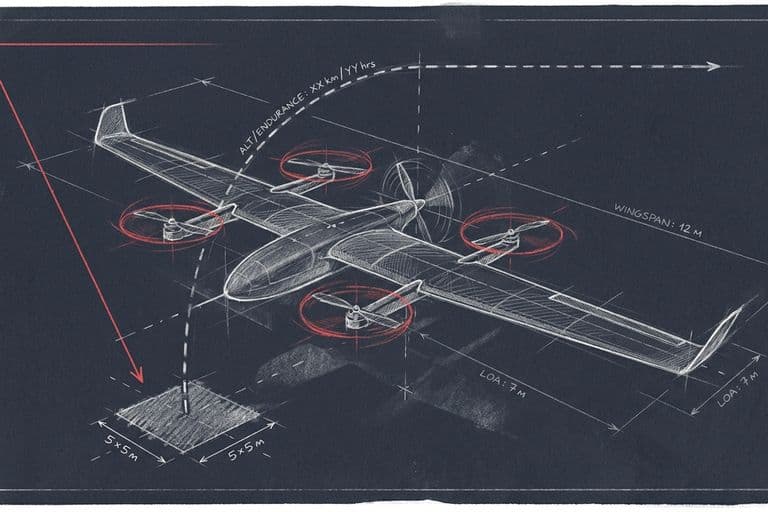
The Dronehub S-2 is a hybrid VTOL fixed-wing UAV with a 35 kg maximum take-off weight, up to 7 hours of endurance and up to 700 km of range (depending on payload), launching vertically from roughly a 5×5 m patch with about 5 minutes of deployment time.
Source · Dronehub, S-2 platform page dronehub.ai ↗
The S-2 uses four electric motors for vertical lift and a single pusher motor for cruise, available as combustion or all-electric; the headline endurance and range figures apply to the combustion-pusher version. Total payload is 6 kg, measured excluding the standard electro-optical system, with a 45 dm³ modular bay taking mission payloads up to 5 kg.
Source · Dronehub, S-2 platform page dronehub.ai ↗
Ukrspecsystems (Ukraine) lists its PD-2 at 55 kg MTOW in VTOL configuration, 8+ hours of endurance and a maximum flight distance of 1,300 km, a figure the page does not split between VTOL and runway configurations — a longer stated distance than the S-2, in a heavier class.
Source · Ukrspecsystems, PD-2 UAS ukrspecsystems.com ↗
4 more key facts
Tekever's AR3 Evo is specified at 25 kg MTOW (up to 30 kg in VTOL), up to 22 hours endurance in fixed-wing and 14 hours in VTOL configuration, a 6 kg payload and a communications range of up to 230 km, with VTOL operation from 5×5 m.
Source · Tekever, AR3 Evo tekever.com ↗
FIXAR 025 (designed in the EU by Riga-founded FIXAR; datasheet issued by FIXAR Global Inc., Alexandria, Virginia) is an all-electric VTOL aircraft with a 25 kg MTOW, up to 210 minutes of flight time, up to 300 km of flight distance and up to 10 kg of payload capacity.
Source · FIXAR, FIXAR 025 technical specifications, 7 July 2025 fixar.lv ↗
Shield AI's V-BAT is a tail-sitter with a 75 kg maximum gross take-off weight, 12+ hours of endurance with an EO/IR payload, an 18.1 kg maximum payload and a 4.6 m × 4.6 m landing zone; Textron's Aerosonde Mk. 4.7 VTOL is rated at 54.4 kg MTOW, 13 hours and 140 km line-of-sight range.
Source · Shield AI, V-BAT — https://shield.ai/v-bat/; Textron Systems, Aerosonde UAS textronsystems.com ↗
NDAA Section 848 (FY2020), as amended by Section 817 (FY2023), bars the US Department of Defense from buying or operating drones, or drones with key components, software or data services, from China, Russia, Iran or North Korea; the law creates no certificate, so compliance is normally a vendor declaration.
Source · 10 U.S.C. 4871 note — https://www.law.cornell.edu/uscode/text/10/4871; Dronehub, Blue UAS vs NDAA vs FCC Covered List — /blog/blue-uas-vs-ndaa-vs-fcc-covered-list
In this piece
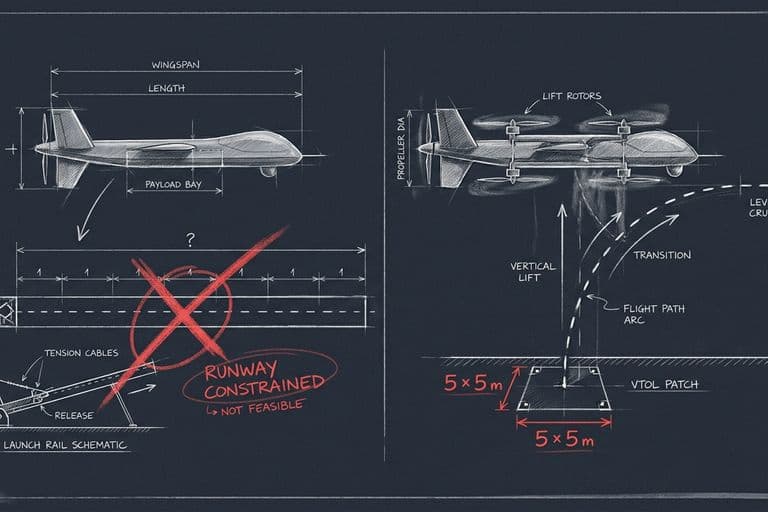
A hybrid VTOL drone is a fixed-wing aircraft with separate lift rotors: it takes off and lands vertically from a small patch, then flies on its wing for hours. Dronehub's S-2 is one, at 35 kg with up to 7 hours of endurance and up to 700 km of range, launching from roughly 5×5 metres. Of the four platforms in this comparison that publish a flight-distance figure, only the heavier Ukrspecsystems PD-2 states more; several others state longer endurance.
Disclosure: this guide is published by Dronehub, which develops the S-2. S-2 figures come from the S-2 platform page; every other figure comes from the maker's own web page or datasheet, read on 29 October 2026. Where a maker does not publish a figure, the table says "not published".
What is a hybrid VTOL drone, and how is it different from a multirotor, a fixed-wing and a tail-sitter?
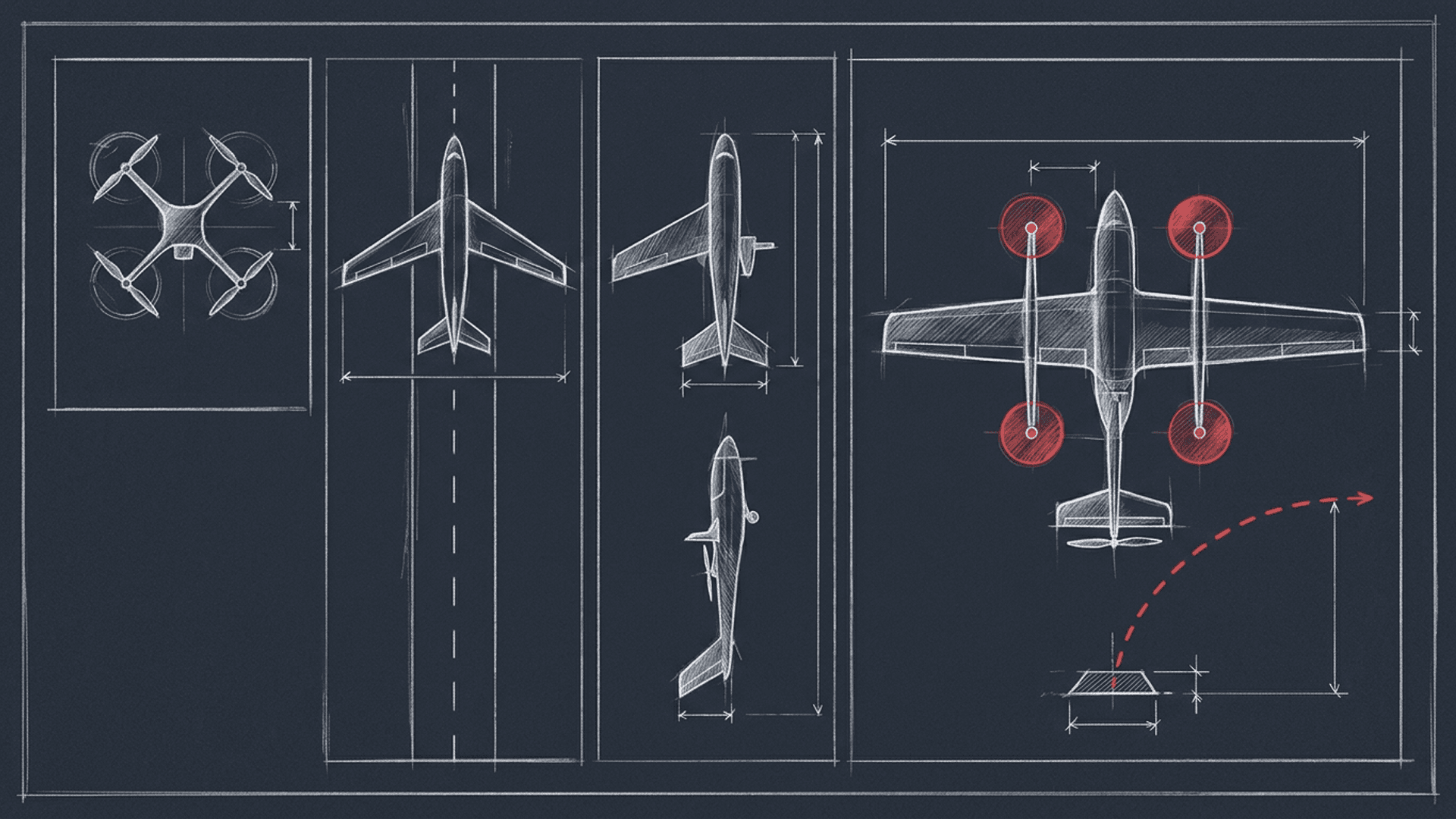
A hybrid VTOL (also called lift-plus-cruise) carries two propulsion systems in one airframe. Rotors on booms lift it straight up, then stop; a pusher or tractor propeller and a fixed wing carry it through cruise. The S-2 breakdown explains the mechanics, and the runway-independence argument explains why the launch site, not the sensor, is usually the binding constraint.
Architecture | Launch and recovery | Endurance and range | Main trade-off | Typical use |
|---|---|---|---|---|
Multirotor | Vertical, any small patch | Tens of minutes; single-digit kilometres | Hovering on rotors is energy-expensive | Short look, inspection of one asset |
Conventional fixed-wing | Runway, catapult or launch rail; net, belly or parachute recovery | Hours; hundreds of kilometres | Needs launch and recovery equipment | Long-dwell ISR from prepared sites |
Tail-sitter VTOL | Vertical; whole airframe stands on its tail | Hours at the high end (V-BAT 12+ h); under an hour for small mapping types | No lift motors to carry, but the whole aircraft hovers upright | Shipboard ISR (V-BAT), survey mapping (WingtraOne) |
Hybrid VTOL (lift-plus-cruise) | Vertical, airframe level on the ground | Hours; hundreds of kilometres | Lift motors are idle weight in cruise | Corridor, border and maritime ISR |
Multirotor and fixed-wing rows follow the physics set out in the two S-2 posts. The tail-sitter row uses maker data: Shield AI's V-BAT and WingtraOne GEN II (4.8 kg, 59 minutes maximum flight time, tail-sitter by the maker's own description) show the same principle at 75 kg and 4.8 kg.
Which long-range VTOL fixed-wing drones are available in 2026, and how do they compare?
The table lists nine non-Chinese platforms in the roughly 10–75 kg class that carry out ISR or inspection tasks, each with the maker's own figures. Three sit above the 50 kg line (PD-2, Aerosonde, V-BAT) and two below 15 kg (Vector AI, DeltaQuad Evo Tactical); they are included because buyers shortlist across the boundary. Class and launch method are labelled.
Maker (country) and platform | MTOW | Endurance | Range | Payload | Launch footprint and method | Propulsion | Notes |
|---|---|---|---|---|---|---|---|
Dronehub (US, EU factory in Poland): S-2 | 35 kg | Up to 7 h | Up to 700 km | 6 kg total (excl. standard EO system); 45 dm³ bay takes up to 5 kg | Vertical, about 5×5 m; about 5 min deployment | 4 electric lift motors plus pusher, combustion or electric; headline figures are combustion | TRL 9; licence, purchase or build-to-spec; optional parachute; wind to 10 m/s; -20 to +40 °C |
Ukrspecsystems (Ukraine): PD-2, VTOL config. | 55 kg | 8+ h | Up to 1,300 km max flight distance (not split by configuration) | Up to 11 kg | Vertical; battery VTOL module recharged by a 300 W onboard generator; footprint not published | 100 cc gasoline engine plus battery-powered VTOL lift | Heavier class; longer stated distance and endurance than S-2; ITAR-free per maker; converts to runway config. |
Tekever (Portugal): AR3 Evo | 25 kg (30 kg in VTOL) | Up to 22 h fixed-wing; 14 h VTOL | Not published; comms range up to 230 km | 6 kg | VTOL from 5×5 m, or catapult; under 5 min case to airborne | Electric, combustion or heavy fuel, by configuration | Modular; catapult or VTOL launch, parachute recovery option |
FIXAR (Latvia / US): FIXAR 025 | 25 kg | Up to 210 min | Up to 300 km | Up to 10 kg | VTOL; 10 min deployment; footprint not published | Electric (Li-ion) | 4 rotors; wind to 15 m/s; maker's headline pairs 4.5 kg payload with 125 km |
Redwire / Edge Autonomy (US): Stalker Block 30 | 22 kg | 8+ h (fuel cell) | Not published; comms up to 160 km | Not published on maker page | VTOL; fits an SUV; 2-person crew; footprint not published | Propane fuel cell or battery | Group 2 / NATO Class I; non-ITAR per maker |
Textron Systems (US): Aerosonde Mk. 4.7 VTOL | 54.4 kg | 13 h (EO/IR) | 140 km line of sight | Up to 14.5 kg | VTOL ("hybrid quadrotor"); under 20 min transport to flight, minimum crew of 3 | Heavy-fuel engine plus quadrotor VTOL lift | Heavier class; footprint not published |
Shield AI (US): V-BAT | 75 kg | 12+ h (EO/IR) | Not published as distance; radio range 130 km or 180 km | Up to 18.1 kg | Tail-sitter; 4.6 × 4.6 m landing zone | Heavy-fuel engine (JP-5), ducted fan | Heavier class; max wind 25 kt; US export authorisation may apply |
Quantum Systems (Germany): Vector AI | 9.5 kg | 180+ min | Not published as distance; data link 60+ km (EU techsheet; 40+ km on US datasheet) | Not published as a figure | VTOL; single-operator set-up under 3 min | Electric | Lighter class; converts to multicopter |
DeltaQuad (Netherlands): Evo Tactical | 11 kg | 244 min | 245 km | 3 kg (1 kg on the maximum-endurance setup) | VTOL; footprint not published | Electric (semi-solid-state Li-ion) | Lighter class; 80 km radio; anti-jam GNSS |
Sources: Dronehub S-2 · Ukrspecsystems PD-2 · Tekever AR3 Evo · FIXAR 025 datasheet · Redwire Stalker Block 30 · Textron Aerosonde · Shield AI V-BAT · Quantum Systems Vector AI and techsheet · DeltaQuad Evo Tactical.
What does the table actually show?
Four readings follow from the published numbers, not from marketing language.
- Flight distance. Only four makers publish one: S-2 (700 km), FIXAR 025 (300 km), DeltaQuad Evo Tactical (245 km) and PD-2 (1,300 km). Of the platforms below 50 kg that publish one, the S-2 states the longest. The PD-2, at 55 kg, states 1,300 km, a figure its page does not split between the VTOL and runway configurations.
- Endurance. AR3 Evo, Aerosonde, V-BAT, PD-2 and Stalker all state 8 hours or more, which is above the S-2's 7 hours. The S-2 states more endurance than FIXAR 025, Vector AI and DeltaQuad Evo.
- Launch footprint. The S-2 (about 5×5 m), the AR3 Evo (5×5 m) and the V-BAT (4.6 × 4.6 m) publish comparable footprints. The S-2 does not claim a smaller one.
- Payload. The S-2's 6 kg total (measured excluding its standard EO system) is equal to the AR3 Evo and below FIXAR 025, PD-2, Aerosonde and V-BAT. Its modular bay is defined by volume (45 dm³) as well as mass.
The S-2's position is therefore a middle one: 35 kg, hybrid layout, long distance for its class, vertical launch from a small patch, and a modular bay. Dronehub states the S-2 is TRL 9 and offers it through licence, direct purchase or build-to-spec; other makers' offer routes and maturity levels are not compared here.
How do I choose between hybrid VTOL platforms?
Work through five questions in order. A platform that fails an early one should not reach the shortlist.
1. What is the mission radius, not the headline range? An out-and-back sortie uses at most half the stated distance before reserve, and a linear corridor flown one way needs a recovery site at the far end. Check also what the number measures: S-2, PD-2, FIXAR 025 and DeltaQuad state flight distance; Tekever, Textron, Shield AI, Redwire and Quantum Systems state link or line-of-sight range. Past the link range you need cellular or satellite relay. The S-2 pairs RadioLink (civil or military) with LTE.
2. What does the payload need: mass, volume, power or all three? The S-2 has 6 kg total and a 45 dm³ bay (50×30×30 cm) taking up to 5 kg per mission payload, with a payload-drop option. Endurance and range fall as payload rises, which is why the S-2 page states both figures "depending on payload". If you need a heavy gimbal plus a radar or relay, the 11–18 kg class (PD-2, Aerosonde, V-BAT) is the honest shortlist; if you need a light EO/IR package at modest range, the lighter electric platforms may do.
3. What does the launch site look like? A 5×5 m clearing, a vehicle bed and a ship deck are different problems. Hover is the wind-sensitive phase of a VTOL: S-2 states wind to 10 m/s, FIXAR 025 to 15 m/s and V-BAT to 25 kt. Temperature matters too; the S-2 states -20 °C to +40 °C.
4. What is the logistics tail? Count crew, fuel and set-up. Aerosonde asks for a minimum crew of three and under 20 minutes from transport to flight; Stalker needs two people; Vector AI one operator. Combustion platforms need fuel stocks (PD-2 uses regular gasoline; V-BAT and Aerosonde use heavy fuel). A battery platform needs charging power instead. The S-2 states about 5 minutes to deploy.
5. What does procurement allow? For US Department of Defense buyers, NDAA Section 848 bars China, Russia, Iran and North Korea content in drones and key components. The law creates no certificate, so ask each maker for a bill-of-materials declaration. Dronehub declares zero components from China or sanctioned states for the S-2 and states that it is Section 848-aligned; ask for the same from every maker you compare. Export-control status also differs: PD-2 and Stalker are described as ITAR-free or non-ITAR by their makers, while a V-BAT distributor brochure (Toll Aviation) notes that US export authorisation may be required. This table does not audit anyone's bill of materials.
Which hybrid VTOL suits border patrol, maritime patrol or pipeline inspection?
Long linear tasks reward the hybrid architecture, since distance and dwell time matter and launch sites are scarce. The S-2 page lists long-range ISR, border and maritime patrol, critical-infrastructure monitoring, search and rescue and force protection as mission classes, flown with electro-optical and thermal payloads from the 45 dm³ bay.
For a pipeline or power corridor, plan in legs: launch near the section, fly an out-and-back or A-to-B leg inside the real radius, land, and move the launch point. A 5-minute deployment on a 5×5 m patch makes moving the launch point part of the workflow instead of a delay. For a border or coastline, the question is persistence on station; here platforms with 12 hours or more (AR3 Evo, Aerosonde, V-BAT) have the clearer advantage on endurance, and the S-2's case rests on its distance, class and deployment profile. For corridor mapping at survey accuracy, the lighter electric platforms and mapping types such as WingtraOne are built for it; the S-2 page does not claim a survey-grade mapping role.
Teams comparing options for corridor and infrastructure work can ask Dronehub for the S-2 payload and sortie profile that matches their asset.
When does a fixed drone-in-a-box fit instead of a VTOL?
A hybrid VTOL goes to the mission. A drone-in-a-box stays at the site and the mission comes to it: a substation, rail yard, port or perimeter flown on a schedule, with the dock recharging or swapping batteries between sorties and no crew on site. Dronehub's dock swaps the battery robotically in about two minutes and operates from -20 °C to +45 °C.
The test is how often the launch point changes. If it never changes and the sorties repeat, a dock reduces the labour per flight. If it moves, or the range is hundreds of kilometres, a field-deployed hybrid VTOL is the better tool. The two are separate Dronehub product lines; the S-2 is not housed in or launched from the dock.
How can I evaluate the S-2 against your shortlist?
Send Dronehub the mission radius, payload, launch site and procurement constraints, and ask for the S-2 profile that matches: sortie length at your payload, the combustion or electric pusher choice, link architecture, and the offer route (direct purchase, IP licence or build-to-spec). The S-2 platform page carries the full specification strip; the technical breakdown is in The S-2 Combat Drone: 7 Hours, 700 km, and a 5-Metre Launch Footprint. For a technical brief or a procurement conversation, open the contact form.
FAQ
- Which long-range hybrid VTOL drones exist for ISR, and where does the Dronehub S-2 fit?
- The S-2, developed by Dronehub, is a 35 kg hybrid VTOL fixed-wing UAV with up to 7 hours of endurance and up to 700 km of range on the combustion-pusher configuration, launching vertically from about 5×5 m. In this comparison of nine non-Chinese platforms it sits in the middle of the weight range: lighter platforms such as FIXAR 025 and DeltaQuad Evo Tactical publish shorter flight distances (300 km and 245 km), while heavier ones such as Ukrspecsystems PD-2 (55 kg, 1,300 km) state more. Several platforms state longer endurance. The S-2 is offered by licence, direct purchase or build-to-spec. Dronehub published this guide and checked other makers' figures on 29 October 2026.
- What is the difference between a hybrid VTOL and a tail-sitter?
- A hybrid VTOL, also called lift-plus-cruise, carries separate rotors for vertical flight and a propeller for forward flight, and the airframe stays level on the ground. The S-2 and Textron's Aerosonde Mk. 4.7 VTOL (which its maker calls 'Hybrid Quadrotor') are examples. A tail-sitter has no dedicated lift rotors: the whole aircraft stands on its tail, hovers nose-up and pitches over into cruise. Shield AI's V-BAT and the WingtraOne mapping drone use this approach. The trade-off is that a hybrid carries lift motors that are idle weight in cruise, while a tail-sitter avoids that weight but must hover, land and be handled as a whole airframe standing upright. Neither is better in every case; it depends on payload layout and site.
- How far can a hybrid VTOL drone actually fly on a mission?
- Less than the headline range for most missions. Stated range is usually the maximum one-way flight distance in good conditions, depending on payload. An out-and-back sortie can use at most half of it, before any reserve, and headwinds, climbs and the vertical phases take more. Makers also publish different things: S-2, PD-2, FIXAR 025 and DeltaQuad Evo state flight distance, while Tekever, Textron, Shield AI and Redwire state data-link or line-of-sight range, which is a different limit. Beyond line of sight, a cellular or satellite link is needed. The S-2 pairs RadioLink with LTE. Compare like with like, and ask each vendor for a profile that matches your payload and altitude.
- Is a hybrid VTOL drone suitable for border patrol or pipeline inspection?
- Yes, where the mission is long, linear and far from prepared launch sites. Hybrid VTOL platforms combine multi-hour endurance with vertical launch from a small clearing, so a team can launch near the section of border or pipeline to be covered instead of travelling to a runway. The S-2 page lists border and maritime patrol, critical-infrastructure monitoring and long-range ISR among its mission classes, with a modular bay for electro-optical and thermal payloads. If the same site is flown every day, a fixed drone-in-a-box may need less crew effort per flight, because nobody has to deploy. The choice follows how often the launch point changes.
- Do NDAA Section 848 and China-free requirements apply when buying a VTOL drone?
- They apply when the buyer is the US Department of Defense or a DoD contractor, and similar rules extend to other federal agencies and to federally funded buyers. Section 848 prohibits drones, and key parts such as flight controllers, radios, cameras and ground software, from China, Russia, Iran or North Korea. The law creates no certificate, so compliance is normally the vendor's own declaration backed by a bill of materials. Dronehub states that the S-2 has zero components from China or sanctioned states and is Section 848-aligned. Request the same bill-of-materials declaration from any maker you compare. European buyers follow EU and national procurement rules, which are different.
- When should I choose a drone-in-a-box instead of a hybrid VTOL?
- Choose a drone-in-a-box when the site is fixed and the sorties repeat on a schedule: a substation, a rail yard, a port, a perimeter. The dock recharges or swaps batteries and launches without a crew on site, so flights can be remote and frequent. Dronehub's dock swaps the battery in about two minutes and operates from -20 °C to +45 °C. Choose a hybrid VTOL such as the S-2 when the launch point moves, the range is long, or the aircraft must reach a place with no infrastructure. The two answer different questions. The S-2 is a field-deployed platform and is not housed in or launched from the dock.