Key facts
DJI Dock 3 charges its Matrice 4D/4TD drone from 15% to 95% in 27 minutes at 25 °C, is rated IP56, operates from -30 °C to 50 °C and allows landing in winds up to 12 m/s; DJI's specification lists charging, not battery swapping.
Source · DJI Enterprise, Dock 3 specs enterprise.dji.com ↗
DJI released Dock 4 on 14 October 2026 with a fully automatic battery swap in under 25 seconds, under 45 seconds from landing to take-off, a -40 °C to 50 °C operating range and IP56 rating; its specification lists the Matrice 5TD as its aircraft, which trade press reports is the only drone it takes, and the page lists no FCC transmitter data.
Source · DJI Enterprise, Dock 4 release — https://enterprise.dji.com/news/detail/dock-4-release; DJI Enterprise, Dock 4 specs — https://enterprise.dji.com/dock-4/specs; DroneXL, 14 October 2026 dronexl.co ↗
In October 2026 a US reseller listed DJI Dock 3 on its own at $15,799, and an EU reseller listed it at EUR 12,960 including VAT (EUR 11,076.92 excluding VAT).
Source · Dronefly — https://www.dronefly.com/products/dji-dock-3; Power Drone power-drone.eu ↗
5 more key facts
Dronehub's drone-in-a-box swaps the battery robotically inside the dock in two minutes, operates from -20 °C to +45 °C, and is built with no components from China, Russia or Iran at the company's factory in Jasionka, Poland.
Source · Dronehub, Drone-in-a-Box dronehub.ai ↗
NDAA Section 848, as amended by Section 817, bars the Secretary of Defense from operating or procuring covered drone systems made in China or using covered components, software or data services, and names Da-Jiang Innovations (DJI) as a covered unmanned aircraft system company; since 1 October 2024 it also bars DoD contracts with entities that operate equipment from a covered company in performing a DoD contract.
Source · U.S. Code, 10 U.S.C. 4871 note (Pub. L. 116-92 §848, as amended by Pub. L. 117-263 §817), via GovInfo govinfo.gov ↗
Since 22 December 2025, drones and drone critical components produced in any foreign country, drone docks included, cannot receive new FCC equipment authorisations unless an exemption applies; the FCC says the producer's nationality is not relevant, and devices authorised earlier can still be used.
Source · FCC, Covered List FAQs: UAS and UAS Critical Components fcc.gov ↗
On 21 July 2026 the FCC proposed (PS Docket 26-189, DA 26-758) to end the importation and marketing of previously authorised, foreign-produced 'military-grade' drone equipment, a category that includes UAS docking stations; the proposal excludes federal government use and would leave equipment already in service authorised for use.
Source · FCC Public Notice DA 26-758 docs.fcc.gov ↗
DJI petitioned the Ninth Circuit on 20 February 2026 to review the FCC's December 2025 decision; as of mid-October 2026 the case was still pending, alongside DJI's petition asking the FCC to reconsider.
Source · DroneXL, 24 February 2026 — https://dronexl.co/2026/02/24/dji-takes-fcc-to-court; DroneXL, 15 October 2026 dronexl.co ↗
In this piece
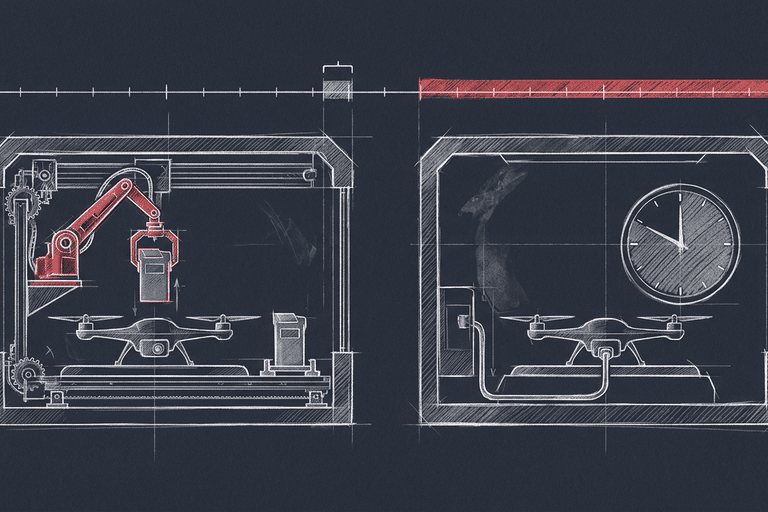
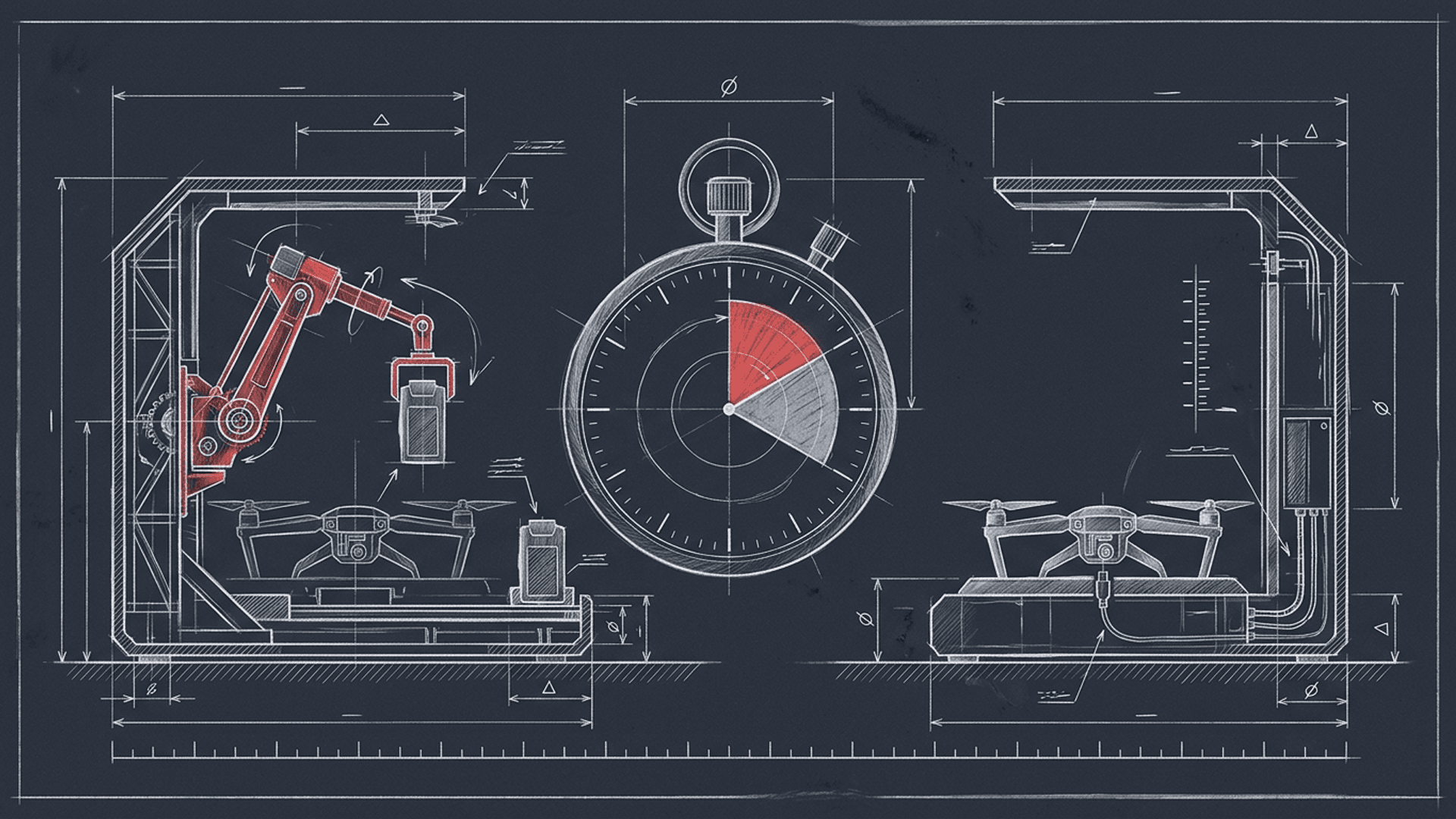
Dronehub's drone-in-a-box is the alternative to the DJI Dock 3 for buyers who need a non-Chinese supply chain and near-continuous flying: a robot swaps the battery in about two minutes, while the Dock 3 charges the drone in place, 15% to 95% in 27 minutes. The Dock 3 wins on published price (about $15,800 dock-only), maturity and temperature range (-30 °C to 50 °C against Dronehub's -20 °C to +45 °C), but DJI is a named covered company under NDAA Section 848 and new DJI models cannot receive FCC authorisation, which closes it to US defense buyers and their contractors.
Disclosure: this guide is published by Dronehub. DJI figures come from DJI's own specification pages, the FCC and the U.S. Code; prices are public reseller listings; Dronehub figures come from its drone-in-a-box page. Where a vendor does not publish a number, the table says so. Data checked on 29 October 2026.
How do Dronehub and the DJI Dock 3 compare side by side?
System | Turnaround between flights | Operating temperature | Ingress and wind rating | Aircraft | Price |
|---|---|---|---|---|---|
Dronehub drone-in-a-box | Robotic battery swap, about 2 min | -20 to +45 °C | Not published | Dronehub multirotor with onboard Nvidia compute | On quote; sold outright or licensed |
DJI Dock 3 | Charges in place, 15→95% in 27 min at 25 °C | -30 to 50 °C | IP56; landing wind to 12 m/s | Matrice 4D / 4TD | $15,799 dock-only (US reseller); EUR 12,960 incl. VAT (EU reseller) |
DJI Dock 4 (released 14 Oct 2026) | Automatic battery swap under 25 s; under 45 s landing to take-off | -40 to 50 °C | IP56; landing wind to 12 m/s | Matrice 5TD only | None on DJI's release or spec page |
Two cautions. The turnaround figures are not measured the same way: DJI quotes Dock 4's swap from cover closed to swap complete, and Dronehub quotes the swap cycle in its own terms. And Dock 4 is new: on speed it beats Dronehub's two minutes, so "DJI charges, Dronehub swaps" is true of the Dock 3 only. We return to Dock 4 below.
Does the DJI Dock 3 swap batteries?
No. DJI's specification lists a 27-minute charge and no swap mechanism; the drone sits on the pad until its battery is full. DJI states that figure at 25 °C and gives none for other temperatures, while listing a battery charging window of 5 °C to 45 °C, so in the cold or the heat the dock must first bring the pack into range.
What that costs depends on the mission. Assume 25-minute missions flown back to back for 24 hours, with no downtime for weather, maintenance or airspace. This is our assumption, not a vendor figure, using the formula in our cost guide: sorties are at most the minutes in the day divided by mission time plus turnaround. A two-minute swap gives up to 53 sorties; the Dock 3's 27-minute charge gives at most 27. That is close to twice the sorties from one dock. Docks that charge in place publish roughly 20 to 35 minutes, and the swap-versus-charge comparison covers the trade-offs, including the extra moving parts and battery inventory a swap dock carries.
If the site flies a few scheduled inspections a day, none of this matters, and the simpler charging dock is the better engineering. If it needs back-to-back coverage, there are two answers. One is a faster turnaround. The other is a second dock: at a published $15,799 per Dock 3, buying two docks for coverage is a real alternative, and we cannot price it against ours because we quote per site.
Then there is the Dock 4. DJI released it on 14 October 2026 with a swap of under 25 seconds. That is faster than anything Dronehub publishes. Its limits are that it works only with the Matrice 5TD, so a Matrice 4D fleet cannot move into it, and that its specification page lists CE, IC, SRRC and MIC certifications but no FCC data. DroneXL reports that it has no path to US sale. For a European operator with no origin constraint, the Dock 4 is the swap dock to price against Dronehub.
Where does the DJI Dock 3 beat Dronehub?
Be clear-eyed about it. On the published record DJI wins in these places:
- Price. DJI's dock has a public price, $15,799 at a US reseller. Dronehub publishes none.
- Temperature range. -30 °C to 50 °C against -20 °C to +45 °C, and -40 °C on the Dock 4.
- Published weather envelope. DJI states IP56 and a 12 m/s landing limit. Dronehub's dock page states neither, so a buyer must ask.
- Ecosystem. The Dock 3 pairs with the Matrice 4D and 4TD, runs on FlightHub 2 (including an on-premises version) and the DJI Cloud API, and is sold through authorised dealers. It is a third-generation dock, and a fourth is already out.
- Site features. A 12 Ah backup battery that DJI says keeps the dock running for over four hours after a power outage, and onboard sensors for wind, rain and temperature.
- Swap speed, with the Dock 4. See above.
Dronehub's case is not that it beats DJI on these lines. It is that it fits where the DJI dock cannot be bought or must not be used, and that its swap suits uninterrupted coverage. Its evidence is field deployment, such as the AI rail inspection it runs for Deutsche Bahn, not a catalogue of dealers.
How do the operating ranges compare for a real site?
A -20 °C floor suits many sites, not all. If a site sees sustained temperatures below -20 °C, the Dock 3's -30 °C and the Dock 4's -40 °C are real advantages. At the hot end the ranges are close (+45 °C against 50 °C). In the cold, the architectures differ: a charge-in-place dock must warm the battery before charging, and DJI does not publish a charge time for other temperatures, whereas a swap dock keeps its next pack warm inside the enclosure. Neither vendor replaces a site trial at your own coldest and hottest hours.
Can a US buyer use a DJI dock in 2026?
It depends on who the buyer is, and the rules are three separate things, set out in our guide to Blue UAS, NDAA and the FCC Covered List.
Section 848 (10 U.S.C. 4871 note) bars the Secretary of Defense from operating or procuring covered drone systems, including those with flight controllers, radios, cameras, ground software or data services from China, and it names DJI as a covered company. Since 1 October 2024 it also bars DoD contracts with entities that operate equipment from a covered company in performing a DoD contract. The Secretary can waive it in writing, and some testing uses are exempt, but a program office should not plan on either.
The FCC Covered List concerns equipment, not buyers. Since 22 December 2025 drones and drone critical components produced in a foreign country, docks included, cannot receive new FCC authorisations unless they are on DCMA's Blue UAS Cleared List, qualify as Buy American domestic end products (both until 1 January 2028) or hold a Conditional Approval. Devices authorised earlier, such as the Dock 3, can still be used. On 21 July 2026 the FCC proposed ending the importation and marketing of previously authorised military-grade foreign equipment, docks among it, with federal government use excluded. We found no final rule when we checked, and DJI is contesting the listing in the Ninth Circuit.
System | NDAA Section 848 (DoD) | FCC Covered List (new US authorisations) |
|---|---|---|
Dronehub drone-in-a-box | Section 848 compatible by design (vendor statement); no components from China, Russia or Iran | Made in Poland, so "produced in a foreign country" under the FCC test; Blue UAS listing not claimed |
DJI Dock 3 | DJI is a named covered company; DoD may not operate or procure | Authorised before 22 Dec 2025: can still be sold and used; no new variants |
DJI Dock 4 | Same position as the Dock 3 | No FCC data on the specification page |
The Dronehub row cuts both ways, and a buyer should read it that way. Dronehub runs joint EU-US R&D, but the FCC says a producer's nationality is not relevant; the test is where the device is produced. Our dock is built in Jasionka, so US federal and grant-funded buyers should ask for the authorisation or exemption route of the exact model, as they should of any foreign-built dock. One European dock, Dronus's K500L station, received a Conditional Approval on 2 October 2026, so the route exists. For a European operator none of these US rules apply, and the DJI dock is a purchase decision on price, features and data.
Where does the data go?
DJI's dock runs on FlightHub 2 and the DJI Cloud API; an on-premises FlightHub version exists, so the cloud is not the only route. For a US defense buyer the issue is wider than hardware: Section 848 also covers ground control or operating software developed in China and network connectivity or data storage administered from there.
Dronehub's dock runs first-pass classification on the drone's Nvidia computer and sends only flagged frames to its Sentinel AI; imagery, telemetry, detections and audit logs stay inside EU and US infrastructure. That is the vendor's statement, and a buyer should test it by asking where each data store is hosted and who administers it.
Should I buy or license?
DJI sells hardware through dealers and licenses fleet software per device: a dock or a drone each counts as one device on FlightHub 2 Enterprise, which a US reseller lists at $3,280 for one device for one year. Dronehub does two things. It sells the drone-in-a-box outright, and it licenses its technology to other drone companies that want to build under their own brand. DJI publishes no comparable route to license its dock design. It matters to an integrator who needs a sovereign dock design more than to an operator who needs one dock next quarter.
When is a dock the wrong tool: long corridors?
A multirotor in a dock covers a site. The Dock 3's Matrice 4D has a maximum operating radius of 10 km and a maximum flight distance of 43 km, and Dronehub's dock lists about 20 km of mission coverage per drone per mission. A pipeline, border or rail line hundreds of kilometres long is a different problem. For that, Dronehub develops and offers the S-2, a separate long-endurance hybrid VTOL aircraft with a 35 kg maximum take-off weight, up to seven hours of endurance and up to 700 km of range, launching vertically from roughly 5×5 metres. It is not docked in the drone-in-a-box. It is a separate aircraft for a different job, not a variant of the dock.
Which one should you choose?
Choose DJI if:
- No rule bars DJI for your buyer: you are a commercial or European operator with no DoD, federal or grant-funding link.
- Price and published specifications drive the decision: $15,799 for the dock, -30 °C to 50 °C, IP56, a mature dealer network.
- You fly scheduled inspections a few times a day, where a charging dock is enough.
- You are in Europe and want automatic swapping at the lowest turnaround: price the Dock 4.
Choose Dronehub if:
- Your buyer needs a non-Chinese supply chain and a Section 848 compatible design, and you can accept that Dronehub claims no Blue UAS listing.
- You need back-to-back coverage from one dock, such as perimeter patrol or alarm response, and a two-minute swap fits.
- You want to buy a drone-in-a-box outright, or license the design to build under your own brand.
- You are happy to scope pricing, weather limits and the FCC route per site.
Choose neither if you need a listed item: Skydio announced on 23 July 2026 that its Dock for X10 joined the Blue UAS Cleared List. Our 18-dock comparison lays out the full field.
Scoping a site? Give us the asset, the flight cadence and the funding source, and we will come back with a technical fit: request one for your site.
FAQ
- What is the best alternative to the DJI Dock 3?
- It depends on which constraint rules the Dock 3 out. If you need a non-Chinese supply chain and near-continuous flying, Dronehub's drone-in-a-box is an alternative: a robot swaps the battery in about two minutes, it operates from -20 °C to +45 °C, and it is built in Poland with no components from China, Russia or Iran. If you need a Blue UAS Cleared dock for US federal work, Skydio announced on 23 July 2026 that its Dock for X10 joined the list. If price and a wide temperature range matter most and no rule bars DJI, the Dock 3 itself is hard to beat: it lists at about $15,800 and works from -30 °C to 50 °C.
- Does the DJI Dock 3 swap batteries?
- No. DJI's specification for the Dock 3 lists a charging time of 27 minutes, from 15% to 95% at 25 °C, and no battery-swap mechanism; the drone stays on the pad while its battery charges. DJI's newer Dock 4, released on 14 October 2026, does swap batteries automatically in under 25 seconds, but it works only with the Matrice 5TD drone, its specification lists no FCC transmitter data, and a trade site reports no path to US sale. Dronehub's drone-in-a-box swaps its battery robotically in about two minutes, so on 25-minute missions flown back to back it can fly close to twice the sorties of a dock that charges in place.
- Is there an NDAA-compliant alternative to the DJI Dock?
- Yes, but check what the label means. Section 848 of the FY2020 NDAA, as amended, bars the Department of Defense from operating or procuring covered drones and names DJI as a covered company; the law creates no certificate, so 'NDAA compliant' is normally a vendor's own declaration. Dronehub states that its dock is Section 848 compatible by design, with no components from China, Russia or Iran, and does not claim a Blue UAS listing. Skydio says its Dock for X10 is on the Blue UAS Cleared List, which DCMA has run since 3 December 2025. Always ask for the exact item on DCMA's list and the FCC authorisation route.
- Can I still buy a DJI Dock 3 in the United States in 2026?
- For a commercial buyer, generally yes: the FCC Covered List, in force since 22 December 2025, blocks new authorisations, and the FCC states that devices authorised earlier can still be imported, sold and used. The Dock 3 was authorised before that date. Two risks remain. Under Section 848 the Department of Defense cannot operate or buy DJI equipment, and it may not contract with companies that operate DJI equipment in performing a DoD contract. And on 21 July 2026 the FCC proposed ending the importation and marketing of previously authorised, foreign-produced 'military-grade' drone equipment, a category that includes docking stations; we found no final rule when we checked on 29 October 2026, and DJI has filed against it.
- How much does a DJI Dock 3 cost compared with Dronehub?
- In October 2026 a US reseller listed the DJI Dock 3 on its own at $15,799, and an EU reseller listed it at EUR 12,960 including VAT; the Matrice 4D or 4TD drone, installation, fleet software and the permissions to fly beyond visual line of sight are extra. Dronehub does not publish a price: it quotes per site, and sells the drone-in-a-box outright or licenses its technology to other drone companies. A fair comparison therefore needs a quote against the full budget, not the sticker price of the dock, which our drone-in-a-box cost guide breaks down line by line.
- Which handles colder and hotter weather, Dronehub or the DJI Dock 3?
- On published ranges the DJI Dock 3 is wider. DJI lists -30 °C to 50 °C for the dock, IP56 and landing winds up to 12 m/s. Dronehub's drone-in-a-box operates from -20 °C to +45 °C, and the company does not publish an ingress rating or wind limit on its dock page. DJI states the 27-minute charge at 25 °C and lists a battery charging window of 5 °C to 45 °C, so outside that window the dock must first bring the pack into range. A swap dock keeps its next pack warm inside the enclosure, which is why the cold-weather turnaround of a swap dock need not stretch.