Key facts
Under 14 CFR 107.41, a Part 107 remote pilot needs prior Air Traffic Control authorization to operate in Class B, C or D airspace or inside the surface area of Class E airspace designated for an airport; the FAA's LAANC system gives near-real-time authorization up to the altitudes on its UAS Facility Maps.
Source · eCFR, 14 CFR 107.41 — https://www.ecfr.gov/current/title-14/chapter-I/subchapter-F/part-107/subpart-B/section-107.41; FAA, LAANC faa.gov ↗
The FAA's letter to airport sponsors says sponsors have the authority to approve or disapprove a small-drone operation on an airport, and that LAANC cannot be used to request authorization for on-airport operations.
Source · FAA, Letter to airport sponsors on UAS on and near airports (dated 26 October 2022) faa.gov ↗
The FAA says a drone cannot be the only means of performing a Part 139 airport self-inspection at this time; it may be used as an additional tool.
Source · FAA, On Airport Unmanned Aircraft System Operations faa.gov ↗
5 more key facts
Regulation (EU) 2019/947 lets Member States define UAS geographical zones that prohibit drone flights, set conditions for them or require prior authorisation, and requires a specific-category operation in controlled airspace to have a procedure for coordination with the relevant airspace service provider.
Source · EUR-Lex, Implementing Regulation (EU) 2019/947, Article 15 and UAS.SPEC.040 eur-lex.europa.eu ↗
NIS2 (Directive (EU) 2022/2555) lists airports and the managing bodies of ports among its sectors of high criticality, and the Critical Entities Resilience Directive (EU) 2022/2557 requires critical entities to ensure adequate physical protection of premises and critical infrastructure, with fencing, barriers and perimeter monitoring tools given as examples; Member States had to identify critical entities by 17 July 2026.
Source · EUR-Lex, Directive (EU) 2022/2555 Annex I and Directive (EU) 2022/2557 Articles 6 and 13 eur-lex.europa.eu ↗
In the US, a port facility regulated under the Maritime Transportation Security Act must have a Facility Security Plan approved by the Coast Guard, and its owner or operator must have the capability to continuously monitor the facility through a combination of lighting, security guards, waterborne patrols, automatic intrusion-detection devices or surveillance equipment.
Source · eCFR, 33 CFR 105.200 and 105.275 ecfr.gov ↗
The FAA says it currently does not support the use of counter-UAS systems at airports by any entity other than the federal departments; since 1 July 2026 certified state, local, tribal and territorial law-enforcement agencies may also conduct counter-UAS operations under the SAFER SKIES Act.
Source · FAA, UAS detection and mitigation at airports — https://www.faa.gov/airports/new_entrants/uas_detection_mitigation_response; Federal Register 2026-13609 federalregister.gov ↗
The Dronehub S-2 is a hybrid VTOL fixed-wing aircraft with a 35 kg maximum take-off weight, up to 7 hours of endurance and up to 700 km of range in its combustion cruise configuration, launching vertically from a patch of about 5×5 m, with wind tolerance to 10 m/s and an operating range of −20 °C to +40 °C.
Source · Dronehub, S-2 platform specification dronehub.ai ↗
In this piece
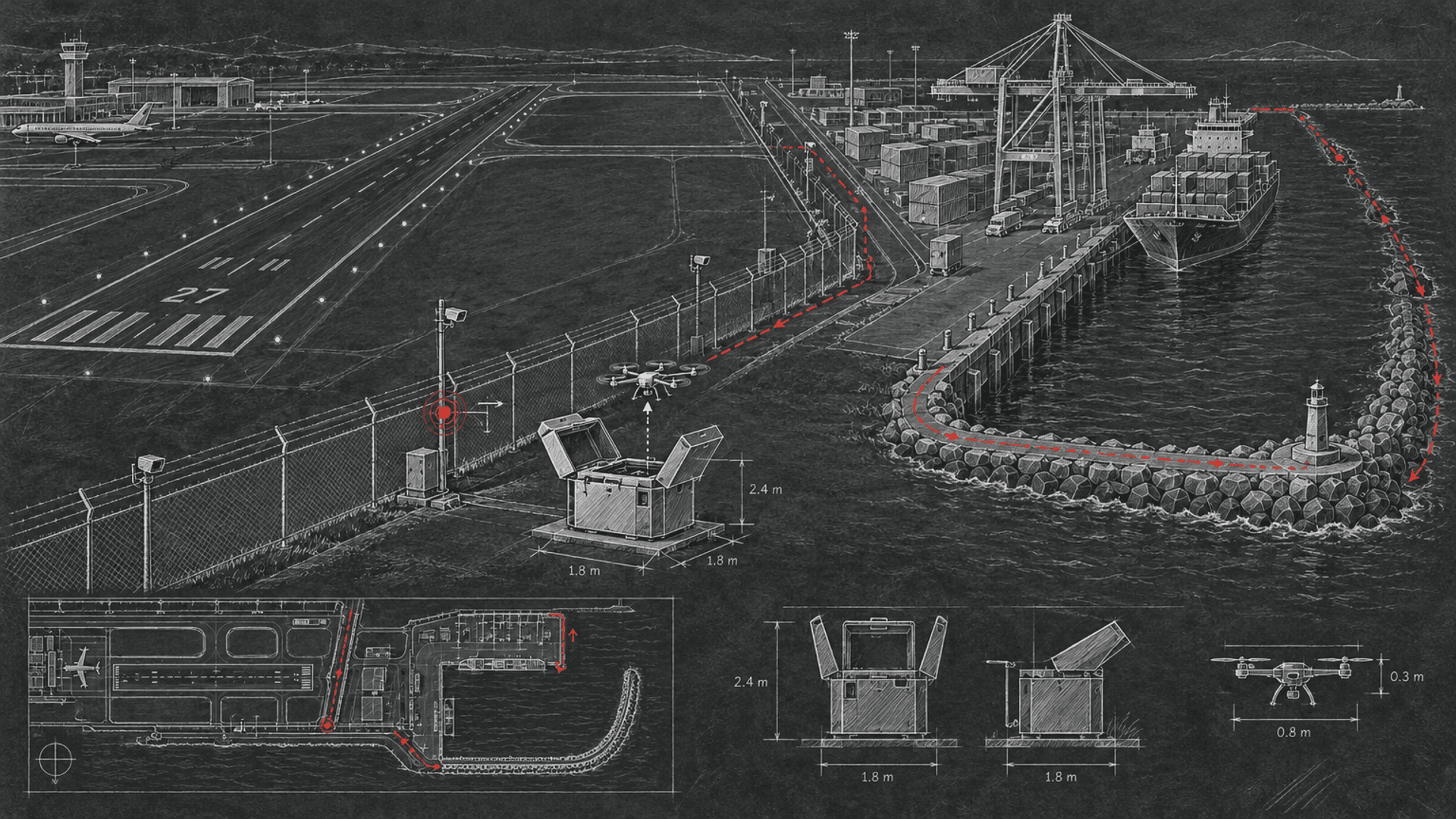
Airports and seaports use drones for five jobs: patrolling the fence and verifying alarms; inspecting runway pavement, airfield lighting and terminal roofs; supporting foreign-object-debris (FOD) and wildlife checks; surveying quay cranes, container stacks, berths, breakwaters and oil terminals; and watching the water-side approach. The aircraft follows the job. A fixed drone-in-a-box serves repeated sorties from one spot, a long-endurance hybrid VTOL covers long coastlines and approach channels, and a crew-flown or tethered multirotor handles close-ups of a crane. The hard part is rarely the aircraft. It is the authorisation: airports sit in controlled airspace, ports are regulated security facilities, and the same flight can need the aviation authority, the air traffic provider, the site operator and, for a US port security measure, the Coast Guard to agree.
Disclosure: this guide is published by Dronehub.
Which drone, sensor and approval fits each airport and port asset?
The table maps each asset to its task, the usual sensor, the aircraft class and who typically has to say yes; the approvers are typical, not a legal ruling for any one site. "Aviation authority" means the national aviation authority in the EU (specific-category authorisation) or the FAA in the US (Part 107, a waiver or an exemption).
Site / asset | Task | Sensor | Aircraft type | Who must authorise it |
|---|---|---|---|---|
Airport perimeter fence and gates | Scheduled patrol, alarm verification | Thermal plus visible-spectrum | Fixed drone-in-a-box | Airport operator; air traffic provider if in controlled airspace; aviation authority |
Runway and taxiway pavement | Condition survey, repeat comparison | High-resolution RGB, photogrammetry | Multirotor, crew-flown or docked | Airport operator; air traffic control; aviation authority |
Airfield lighting | Light-fitting and cabling checks | Zoom RGB, thermal at night | Multirotor | Airport operator; air traffic control |
Apron and shoulders (FOD support) | Debris survey between sweeps | High-resolution RGB | Multirotor | Airport operator; air traffic control |
Wildlife near the field | Observation near the field | Thermal | Docked multirotor | Airport operator; air traffic control |
Terminal and hangar roofs | Roof and drainage survey | RGB, thermal | Multirotor | Airport operator; aviation authority |
Quay cranes | Structural close-ups, corrosion, welds | Zoom RGB | Tethered or crew-flown multirotor | Terminal operator (permit to work); aviation authority |
Container stacks and yard | Fence line, stack condition | RGB, thermal | Fixed drone-in-a-box | Port facility security officer; aviation authority |
Berths and quay walls | Wall, fender and bollard condition | RGB, thermal | Multirotor | Port authority; aviation authority |
Breakwaters and oil terminals | Structure and hot-spot inspection, fence line | Zoom RGB, thermal | Docked multirotor or crew-flown | Terminal operator; aviation authority |
Water-side approach and coastline | Long patrol along channels and shore | EO/IR | Long-endurance hybrid VTOL | Aviation authority; maritime and port authorities |
Two things stand out. The airfield rows route through air traffic control, because at a controlled airport the work sits inside the control zone. And the port rows route through the operator's security officer, because a port facility is a regulated security site, not just an industrial yard.
How do the aircraft types differ?
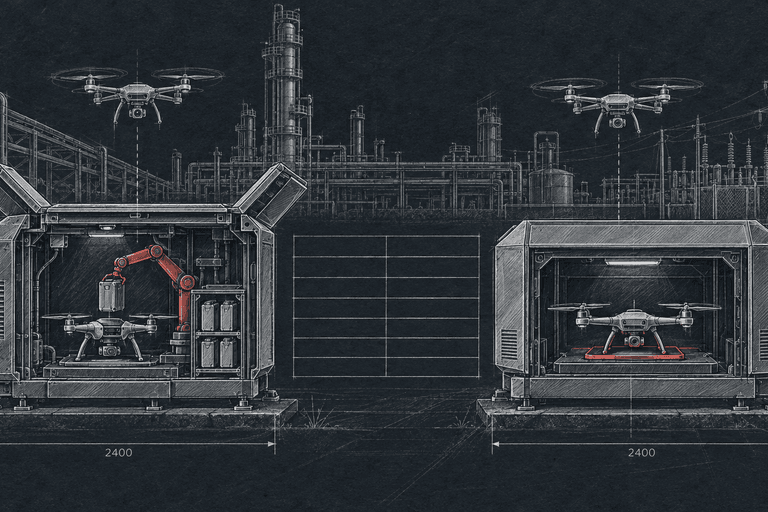
Fixed drone-in-a-box. A weatherproof dock sits beside the fence, quay or apron, launches a multirotor on a schedule or a trigger, recovers it and prepares the next flight without a pilot on site. It fits any task that repeats from the same place: patrol, alarm verification, a daily pavement or yard check.
Long-endurance hybrid VTOL. Vertical-lift rotors and a fixed wing give vertical launch with fixed-wing endurance. It fits boundaries that are too long for a dock's radius: kilometres of coastline, an approach channel, an outer breakwater.
Tethered or crew-flown multirotor. A quay crane, a roof or a lighting run needs a pilot who can fly close, hover and look again. A tethered aircraft adds power and a secure link, which suits long hover time on one structure.
Most airports and ports end up with a mix. Docks do the repeated work, crews do the one-off close-ups, and a long-range aircraft covers the edges.
What are the airspace rules for airports and ports in the EU?
Specific category. Under Regulation (EU) 2019/947, operations that do not meet the open-category limits need an operational authorisation from the national competent authority, backed by a risk assessment. EASA's accepted method is SORA, now in version 2.5. Open-category rules also cap the aircraft at under 25 kg, line of sight and 120 m, so patrol and inspection programmes at airports and ports almost always sit in the specific category.
Controlled airspace and geographical zones. When any part of the operation is in controlled airspace, the Annex to the regulation (UAS.SPEC.040) requires a procedure for coordination with the relevant airspace service provider. Under Article 15, Member States may define geographical zones that prohibit drone flights, set conditions or require prior authorisation, and EASA's own guidance gives areas near airports as an example of such zones. The EU pages we checked do not say whether the permission comes from the air navigation service provider or the aerodrome operator in each case; that is set by national rules, so ask your national authority which party issues it.
U-space. Implementing Regulation (EU) 2021/664 has applied since 26 January 2023. A U-space airspace is a zone designated by a Member State where drones may fly only with the support of U-space services, provided by certified providers: network identification, geo-awareness, flight authorisation and traffic information. If your airport or port sits inside one, the operator's flight planning has to connect to those services.
NIS2 and the CER Directive. These explain why operators are buying, not what they may fly. NIS2 covers airports and the managing bodies of ports, and Member States had to apply it from 18 October 2024. The Critical Entities Resilience Directive required Member States to identify critical entities by 17 July 2026; those entities must ensure adequate physical protection of premises and infrastructure, and the directive names fencing, barriers and perimeter monitoring tools as examples. A drone patrol is one way to evidence that, but neither directive replaces an aviation authorisation.
Sector security law. Airport security runs under Regulation (EC) No 300/2008 and Implementing Regulation (EU) 2015/1998; port facilities under Regulation (EC) No 725/2004 and Directive 2005/65/EC. We found no EU page that says a drone patrol needs separate approval inside these rules, so confirm with your security authority how a drone-based measure is recorded in your security programme or plan.
What are the airspace rules in the United States?
Controlled airspace near airports. Under 14 CFR 107.41, a Part 107 pilot needs prior Air Traffic Control authorization to fly in Class B, C or D airspace or inside the surface area of Class E airspace designated for an airport. The FAA's LAANC gives near-real-time authorization, and its UAS Facility Maps show the maximum altitudes around airports where the FAA may authorize flights without additional safety analysis.
On airport property. LAANC does not cover it. The FAA's letter to airport sponsors says sponsors have the authority to approve or disapprove a small-drone operation on an airport and that LAANC cannot be used to request on-airport authorization. For Part 139 airports, the FAA's on-airport page adds that a drone cannot be the only means of performing a self-inspection at this time, and that drone use for perimeter inspection may need to be tied to the sponsor's security programme. TSA approves that programme under 49 CFR 1542.101; we found no TSA statement on drone patrols specifically.
Beyond visual line of sight. A docked patrol that leaves the operator's sight needs a waiver of 14 CFR 107.31 under 107.205, or an exemption. The FAA's proposed Part 108 (published 7 August 2025) would create a standing BVLOS framework, but a Federal Register search on 29 October 2026 found no final rule.
Seaports. The Coast Guard and TSA split the work: the Coast Guard oversees security at facilities covered by the Maritime Transportation Security Act, and TSA runs airport security under 49 CFR Part 1542. A covered port facility must have a Facility Security Plan approved by the Coast Guard (33 CFR 105.200) and must be able to continuously monitor the facility through lighting, guards, waterborne patrols, intrusion-detection devices or surveillance equipment (105.275). Drones are not named, so whether a patrol counts is a question for your plan and your Captain of the Port. One example of local practice: a Coast Guard bulletin from the New Orleans Captain of the Port, dated 12 January 2024, requires facility and vessel representatives to notify the National Response Center of suspicious drone activity.
Flight restrictions. The FAA's proposed rule implementing Section 2209 (91 FR 24650, 6 May 2026) would let fixed-site facilities request drone flight restrictions. For seaports it requires facilities regulated under the Maritime Transportation Security Act with an active Facility Security Plan, and it leaves airports to the FAA's existing framework. It is a proposal; we found no final rule.
Who may deal with a hostile drone over an airport or port?
Not the operator, in most cases. The FAA says it currently does not support counter-UAS systems at airports by any entity other than the federal departments, and since 1 July 2026 certified state, local, tribal and territorial agencies can also act under the SAFER SKIES Act. In the EU, the Commission's 2026 communication keeps operational incident response with Member States. Operators generally own detection, logging and the hand-over to the police or security formations. The legal map by country is in our guide to counter-UAS without jamming for critical infrastructure; this post covers drones as inspection and security tools only.
How does a drone-in-a-box fit site-bound airport and port work?
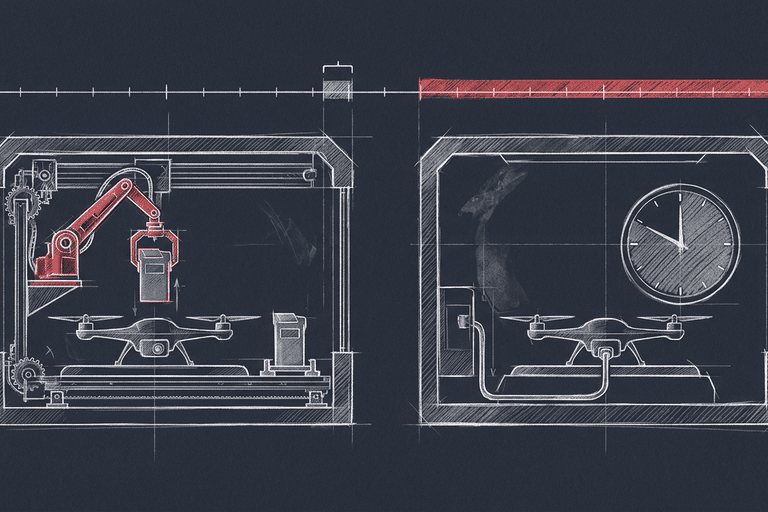
The dock suits any job that repeats from the same place. Dronehub's drone-in-a-box launches on a schedule or on a trigger such as a dispatcher alert or a ground-sensor signal, flies the route, lands, swaps the battery with a robot in about two minutes and stages the next flight. Launch takes under 30 seconds. The operator sees flagged anomalies rather than raw video, and imagery stays on EU and US infrastructure, which matters to operators under NIS2 or the CER Directive. The dock is rated for −20 to +45 °C.
A perimeter-patrol video on the dock page shows the loop: scheduled missions, alarm-triggered launches and automatic recovery. For an airport, that means a fence alarm can send an aircraft to the spot; for a port, the loop covers the fence line, the container stacks and the quay edge. The dock page lists fixed-site protection at ports and airfields among its uses, along with port container monitoring.
Docks that charge in place publish about 20 to 35 minutes of turnaround; a two-minute swap gives close to twice the sorties over a day. The comparison is in robotic battery swap versus in-station charging and the wider market in drone-in-a-box systems compared. For the port view of the same platform, see drone-in-a-box for ports.
Two limits apply. A dock is a ground installation, so siting it on airport or terminal land is the operator's decision, and every route inside a control zone still needs the approvals above. And the dock flies a multirotor: it is for repeated sorties around the site, not for tens of kilometres of coastline. See the critical-infrastructure overview for the wider asset classes.
Where does a long-endurance hybrid VTOL fit?
For long perimeters and coastlines, the S-2 is the long-range tool. It is a hybrid VTOL fixed-wing aircraft: 35 kg maximum take-off weight, up to 7 hours of endurance and up to 700 km of range in the combustion cruise configuration. It launches vertically from about 5×5 m, tolerates wind to 10 m/s and works from −20 °C to +40 °C. The modular payload bay takes electro-optical and thermal packages. Details are on the S-2 page, and the aircraft class is compared in hybrid VTOL drones compared.
Use it for ISR-style patrol of a long coastline, an approach channel or the outer edge of a large port, where a dock's radius runs out. Do not plan it for airside work inside a control zone without authorisation from the air traffic provider and aviation authority. The S-2 is not docked in the drone-in-a-box. At 35 kg it is also above the 25 kg open-category ceiling in the EU and above the 55-pound small-UAS limit of Part 107 (14 CFR 107.3), so expect a specific-category authorisation in Europe and a different pathway than Part 107 in the US.
What should be settled before the first flight?
- The route and altitude, drawn against the control zone, geographical zones and any U-space airspace, and agreed with the air traffic provider.
- The site approvals: the airport operator or sponsor, the terminal's permit to work, the port facility security officer.
- The security record: how the patrol appears in the airport security programme or the Facility Security Plan.
- The authorisation basis: specific-category authorisation in the EU, a waiver or exemption for BVLOS in the US.
- The alarm chain: which sensor triggers a launch, who sees the video and who calls the police or security formation.
- The data path: where imagery is stored, who can see it and how long it is kept.
How do you buy this?
Dronehub offers three routes for the dock. Buy the system: the manufactured drone-in-a-box with AI stack, operator interface and deployment support, under a standard commercial agreement. License the technology: hardware design, autonomy software and docking systems for integrators and OEMs building their own product. Co-develop a variant: a joint R&D engagement for an asset class or sensor the standard system does not cover. The S-2 is offered separately, as a purchase, a licence or a build-to-spec configuration.
Start with one segment: a fence section, one berth, one runway edge. Fly it long enough to compare the findings with your existing inspection records. To scope a site with us, get in touch.
FAQ
- How do Dronehub's dock and the S-2 split airport and seaport work?
- Dronehub's drone-in-a-box is the site-bound tool: a weatherproof dock beside the fence, quay or apron that launches a multirotor on a schedule or on an alarm, recovers it automatically and swaps the battery in about two minutes, so the same spot can be patrolled or inspected again and again. The S-2 is a different aircraft for a different job: a 35 kg hybrid VTOL with up to 7 hours of endurance, flown for long coastlines, approach channels and outer boundaries that a dock's radius cannot cover. The S-2 is not docked in the drone-in-a-box. Close-ups of a quay crane or a roof are usually crew-flown multirotor or tethered work, and every flight still needs the airspace and site approvals described in this guide.
- Can you fly a drone at an airport?
- Only with authorisation, and it comes from more than one party. In the US, Part 107 flights in controlled airspace near an airport need FAA air traffic authorization, usually through LAANC, and a flight on airport property also needs the airport sponsor's approval, which is requested outside LAANC. In the EU, Member States define geographical zones near airports and can require prior authorisation, and a specific-category operation in controlled airspace needs a procedure for coordination with the airspace service provider.
- What drone approvals do EU airports and ports need?
- Most airport and port inspection falls into the 'specific' category of Regulation (EU) 2019/947: an operational authorisation from the national aviation authority, based on a risk assessment such as SORA, with coordination with the airspace service provider if any part of the flight is in controlled airspace. National geographical zones near aerodromes add prior-authorisation requirements, and in a designated U-space airspace drones may fly only with certified U-space services. Separate from aviation law, NIS2 and the Critical Entities Resilience Directive push airport and port operators to protect their sites, which is why perimeter patrol and inspection programmes are being funded, but neither directive authorises a flight.
- Do US ports need Coast Guard approval to use drones for security?
- The Coast Guard regulates security at ports covered by the Maritime Transportation Security Act, and each covered facility operates under a Facility Security Plan that the Coast Guard approves. The monitoring rule, 33 CFR 105.275, lists lighting, guards, waterborne patrols, intrusion-detection devices and surveillance equipment; it does not mention drones. We found no national Coast Guard policy on facilities flying their own drones, so a drone patrol that is meant to count as a security measure should be agreed with the Captain of the Port and written into the plan. The FAA still controls the airspace, and its pending Section 2209 rule would let MTSA-regulated seaports with an active plan request flight restrictions.
- Which drones work for airport perimeter patrol?
- For repeated patrols and alarm verification along the same fence, a drone-in-a-box fits best: the aircraft is already at the site, launches in under 30 seconds and returns to a dock that swaps its battery, so there is no pilot travelling to the gate. Thermal plus visible-spectrum cameras are the usual pairing for night and low-light work. A long-endurance hybrid VTOL suits very long or remote boundaries, such as coastal approaches, but flying it inside controlled airspace needs the same authorisations as any other aircraft. Whichever you choose, expect the airport operator, air traffic control where the airspace is controlled, and the aviation authority to sign off on the route before the first flight.
- Can drones replace runway and airfield inspections?
- Not on their own. In the US, the FAA says a drone cannot be the only means of performing a Part 139 airport self-inspection at this time and may be used as an additional tool; it also says drone use for perimeter inspection may need to be tied to the sponsor's security programme. Drones add value around the mandated inspections: faster pavement and lighting surveys, roof and apron structure checks, wildlife observation near the field and repeatable imagery for comparing one survey with the last. Ask the airport operator and the national authority how a drone-based check is recorded before you rely on it for compliance.
- Can an airport or port operator use counter-drone systems?
- Generally not to mitigate. Detection depends on the technology and the country, but disabling or taking over a drone is reserved to authorised agencies in most of the US and EU. The FAA says it does not support counter-UAS systems at airports by anyone other than federal departments, and the European Commission's 2026 communication keeps operational incident response with Member States. Since July 2026 certified US state, local, tribal and territorial agencies can also act. Poland is a notable exception for specialised armed security formations. Operators usually own detection, logging and the hand-over to the police. Our guide to counter-UAS without jamming covers the legal map and vendors.
- Should an airport or seaport buy a drone-in-a-box, license the technology or fund R&D?
- Buy the dock when you are an asset operator who wants a working system under a standard commercial agreement: hardware, AI stack, operator interface and deployment support. License the technology when you are an integrator, OEM or platform company that wants to build the capability into your own product and contracts. Choose a research partnership when your site needs something the standard system does not do, such as a new sensor, a different asset class or a defence-funded programme. A sensible start with any route is one segment, so patrol and inspection can be tested before the scope widens.