Key facts
The FCC says federal law, including 47 U.S.C. §§ 302a(b) and 333, prohibits the operation, marketing or sale of jamming equipment that interferes with authorized radio communications, and that there are no exemptions for use within a business.
Source · FCC, Jammer Enforcement fcc.gov ↗
The 2020 DOJ–DHS–FAA–FCC advisory states that Congress had authorized only the Departments of Defense, Energy, Justice and Homeland Security to detect and mitigate drones notwithstanding certain federal laws, and that radar, EO/IR and acoustic detection is less likely to raise federal surveillance-law concerns than RF systems that capture drone-to-controller communications.
Source · FAA, Interagency Legal Advisory on UAS Detection and Mitigation Technologies faa.gov ↗
The SAFER SKIES Act, signed on 18 December 2025 in the FY2026 NDAA, lets trained and certified state, local, tribal and territorial law-enforcement and correctional agencies conduct counter-UAS operations, including to protect critical infrastructure; the DOJ–DHS interim final rule took effect on 1 July 2026 and the authority ends on 31 December 2031.
Source · Federal Register, 2026-13609, Counter-UAS Authority for SLTT Law Enforcement and Correctional Agencies federalregister.gov ↗
3 more key facts
The European Commission published its Action Plan on Drone and Counter-Drone Security on 11 February 2026, built around preparedness, detection capacities, coordinated responses and the EU's defence readiness.
Source · European Commission, DG DEFIS defence-industry-space.ec.europa.eu ↗
Bird & Bird's analysis of the EU action plan notes that, generally, neither the private sector nor critical-infrastructure operators have legal authority to take positive action to disable a malicious drone, and that the plan aims for an EU-level counter-UAS regulatory framework by 2030.
Source · Bird & Bird, European Commission Counter-UAS Action Plan (2026) twobirds.com ↗
Poland's Act of 29 May 2026 (Dz.U. 2026 poz. 815), in force since 4 July 2026, adds Article 6zj to the Crisis Management Act: a critical-infrastructure operator that has notified the interior minister, the telecoms regulator UKE and the military frequency-management unit may, in the drone-threat cases the law lists, allow staff of specialised armed security formations to use devices that block telecommunications for the time necessary.
Source · Dziennik Ustaw 2026 poz. 815 dziennikustaw.gov.pl ↗
In this piece
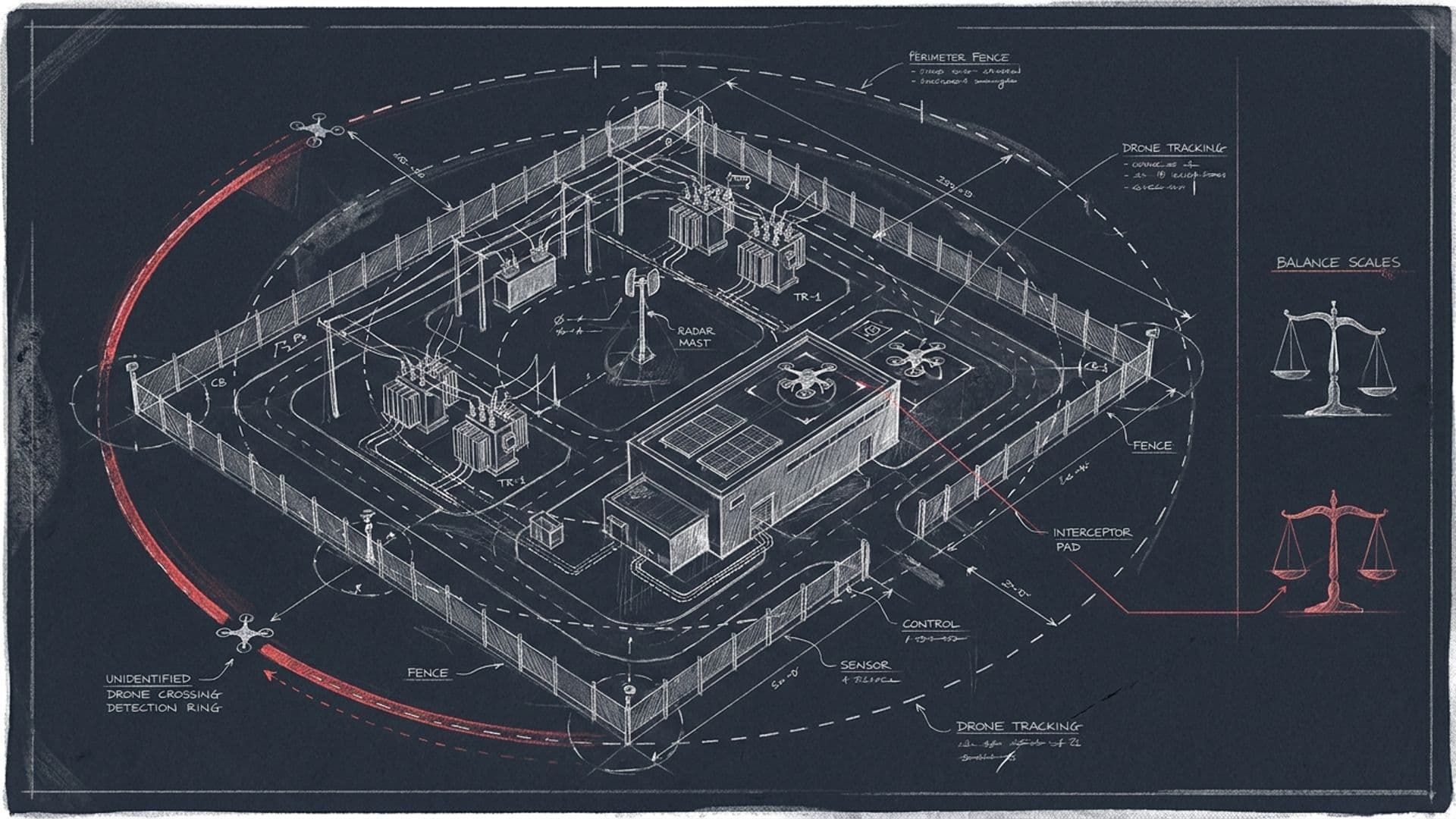
Critical-infrastructure sites that cannot jam — in the US, the UK and most of the EU that means every private operator — build counter-drone protection from two parts: detection they own (radar, RF sensing, electro-optical/infrared cameras, acoustic arrays, Remote ID) and mitigation that does not rely on broadband jamming (cyber takeover of the drone's control link, net-capture interceptors and launchers, and, on military sites, high-power microwave). "Without jamming" does not mean "without legal limits": in most jurisdictions, taking control of or bringing down a drone is still reserved to authorised agencies. So the operator's realistic job is to detect, document and hand over — and to choose vendors whose mitigation layer the authorities can run.
This guide maps the options, the law in the US and the EU's main markets, and 16 vendors.
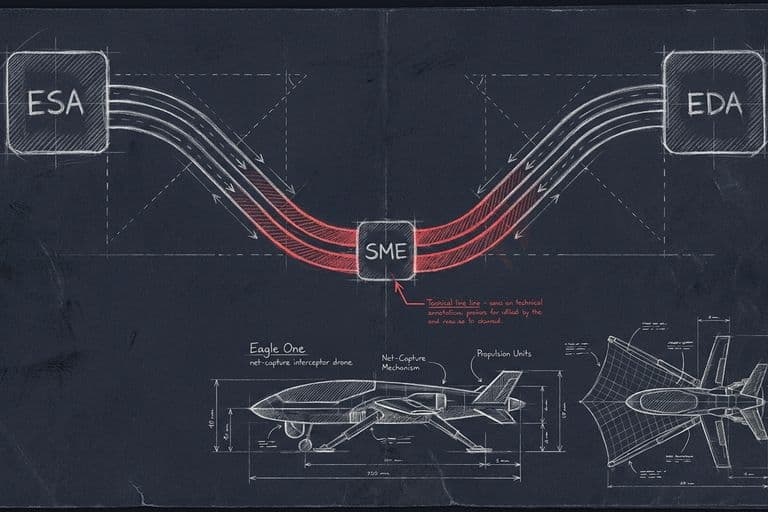
Disclosure: Dronehub led AUDROS, a counter-UAS R&D programme co-funded by the European Space Agency and the European Defence Agency that developed a net-capture interceptor. It appears in the vendor table as an R&D reference. The table is grouped by layer, not ranked.
Why jamming is off the table
United States. The FCC says federal law prohibits the operation, marketing or sale of jamming equipment that interferes with authorised radio communications, with no exemption for use within a business; federal law enforcement may use jammers only in limited cases. Since July 2026, state and local agencies certified under the SAFER SKIES Act may also use authorised mitigation systems, subject to FCC authorisation. Private operators may not.
United Kingdom. Section 68 of the Wireless Telegraphy Act 2006 makes it an offence to use apparatus to interfere with wireless telegraphy, punishable by up to two years in prison.
European Union. Jamming is governed by national telecoms and police law, and in practice reserved to the state. Law firm Bird & Bird, analysing the Commission's 2026 action plan, notes that generally "neither the private sector nor critical infrastructure operators have legal authority to take positive action to disable a malicious drone."
Poland is the exception. The Act of 29 May 2026 (Dz.U. 2026 poz. 815), in force since 4 July 2026 and implementing the EU's critical-entities resilience directive, adds Article 6zj to the Crisis Management Act. A critical-infrastructure operator that has notified the interior minister, the telecoms regulator UKE and the military frequency-management unit may, in the drone-threat cases the law lists, allow staff of specialised armed security formations to use devices that block telecommunications for the time necessary. It must report each use at once, and the interior or defence minister can order it to stop. It is a narrow, procedural permission — not a licence to jam at will.
Jamming also has technical limits against drones that fly pre-programmed routes, which our counter-UAS methods comparison covers. The rest of this guide assumes jamming is not available to you.
Detection: the layer operators own
Sensor | What it sees | Limits | Legal note (US) | Examples |
|---|---|---|---|---|
Radar | The aircraft itself, whatever its control link | Small targets and clutter need good classification | Less likely to raise surveillance-law concerns | Robin Radar, Echodyne, APS, Hensoldt |
RF sensing | Control and video links; often make, model and pilot position | Little to see if the drone flies without a radio link | May implicate the Wiretap Act and Pen/Trap Statute if it captures communications — get legal review | Dedrone, Aaronia, DroneShield |
EO/IR cameras | Visual confirmation by day and night | Needs cueing from radar or RF | Less likely to raise concerns | Part of integrated platforms such as Hensoldt's Elysion |
Acoustic arrays | Rotor and motor noise, passively | Short range; industrial noise | Less likely to raise concerns | Squarehead |
Remote ID receivers | Broadcast identity of compliant drones | Only cooperative drones | Reads what the drone itself broadcasts | Dedrone and others |
The legal notes come from the 2020 US interagency advisory issued by the Justice Department, DHS, the FAA and the FCC. It warns critical-infrastructure owners and operators that federal laws may prevent, limit or penalise the sale, possession or use of detection and mitigation tools, and it separates systems that reflect energy off an object — radar, EO/IR, acoustic — from RF systems that intercept the drone's communications. No single sensor covers every case, so serious sites combine at least radar and RF with camera verification.
Mitigation without jamming
Category | What it does (capability level) | Considerations | Who may operate it | Examples |
|---|---|---|---|---|
Cyber takeover | Takes control of a drone's known protocol and lands it at a designated place | Works on supported protocols only | US: authorised federal agencies and certified state and local agencies; EU: authorities | D-Fend Solutions, Sentrycs |
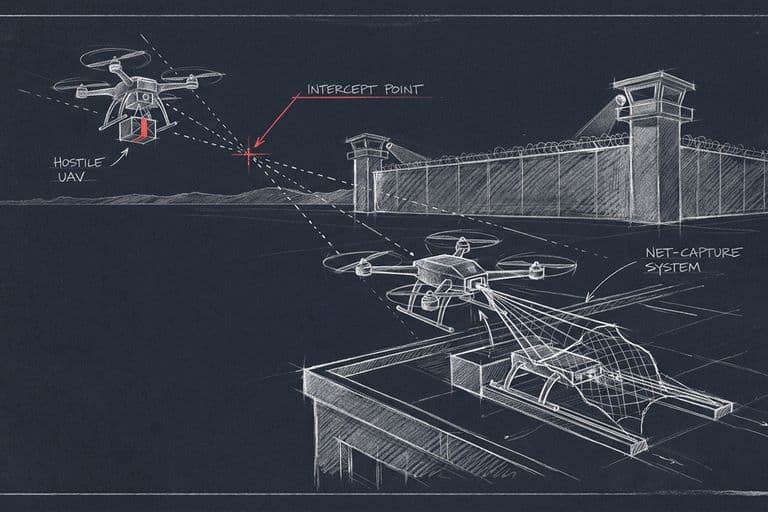
Net-capture interceptor drones | An autonomous drone captures the target with a net and brings it down intact | Falling-object risk is managed, not removed | Authorities in most jurisdictions | Fortem, Delft Dynamics, Eagle.One |
Ground-launched nets | A launcher fires a net at a drone | Operator-aimed; trained operators needed | Authorities in most jurisdictions | OpenWorks SkyWall |
High-power microwave | Disables drone electronics, including groups of drones | Military and defended-site use | Armed forces | Epirus |
Two legal points apply to every row. The US advisory lists nets and projectiles, and hacking and spoofing, among the techniques that may implicate federal laws protecting aircraft, computers and communications. And bringing a drone down intact — in a net, or by landing it through a cyber takeover — also preserves evidence for investigators, which matters when the goal is attribution rather than only stopping one flight. Our net-capture explainer covers the engineering side.
The legal map in 2026
Jurisdiction | Operator may detect | Operator may mitigate | Who mitigates | What changed recently |
|---|---|---|---|---|
United States | Yes, with legal review for RF systems | No | Defense, Energy, Justice and Homeland Security; since 1 July 2026 also certified state, local, tribal and territorial agencies | SAFER SKIES Act; authority runs to 31 December 2031 |
Germany | No explicit legal basis; passive detection used in practice | No | Police; armed forces may assist | Aviation Security Act amended (in force 17 March 2026); Federal Police Act reform passed September 2026 |
Poland | Yes | Through specialised armed security formations: act against a threatening drone (Aviation Law, Art. 156ze); since July 2026 also jamming, after notification (Art. 6zj) | Security formations at protected sites; police; armed forces | Article 6zj in force since 4 July 2026 |
United Kingdom | Yes, with legal review | No | Police and prison authorities | Police Act amendments let senior police and prison officials authorise effectors |
EU level | — | — | Member States | Action plan of February 2026; EU framework targeted for 2030 |
United States. The SAFER SKIES Act, signed on 18 December 2025 in the FY2026 NDAA, lets trained and certified state, local, tribal and territorial law-enforcement and correctional agencies conduct counter-UAS operations, including to protect critical infrastructure. The Justice Department and DHS put it into effect with an interim final rule from 1 July 2026, with a two-tier certification for detection-and-warning and for mitigation operations. The authority is given to agency officers and employees, not to private operators — so the practical change for a utility or refinery is that the local police may now be the ones who can respond.
Germany. The amended Aviation Security Act, in force since 17 March 2026, lets the armed forces assist the police against drones — as a last resort with armed force — and moves the decision to the Defence Ministry. A Federal Police Act reform that gives the Federal Police powers against dangerous drones passed the Bundestag on 25 September 2026. Operators have little room: the Bundestag noted in February 2026 that critical-infrastructure operators have no explicit legal basis to detect or counter drones, and asked the government to examine one. A German security-services firm's summary puts current practice plainly: private parties may detect and document, but may not intercept, jam or destroy drones.
Poland. Article 6zj adds jamming to powers Polish security staff already had: under Article 156ze of the Aviation Law, staff of specialised armed security formations — alongside the police and other services — may destroy, immobilise or take control of a drone that threatens a protected site, and the 2026 Act extends these powers to unmanned vessels and ground vehicles. Military air defence runs separately: the Armaments Agency signed the SAN counter-drone programme with a PGZ–Kongsberg consortium in January 2026, worth about PLN 15 billion, with APS supplying radars and the command system; and the US-made MEROPS interceptor system has been delivered to Poland and Romania. Those are armed-forces tools, not site-operator products.
EU level. The Commission's Action Plan on Drone and Counter-Drone Security, published on 11 February 2026, focuses on preparedness, detection capacity, coordinated response and defence readiness. Bird & Bird reads it as recommending voluntary performance standards for counter-UAS systems by the end of 2026 and aiming for an EU-level regulatory framework by 2030.
Vendors compared
How we chose them: each sells detection or mitigation relevant to fixed critical-infrastructure or defended sites and describes that capability on its own website. The table is grouped by layer — detection first, then mitigation — and is not a ranking.
Vendor | HQ | Layer | Mitigation offered | Note |
|---|---|---|---|---|
US (part of Axon) | RF detection, Remote ID, C2 software | Jamming (DedroneDefender) | RF sensors plus DedroneTracker.AI software | |
Germany | RF detection (AARTOS) | — | Spectrum-analysis heritage | |
Netherlands | Radar (IRIS) | — | 360° 3D radar with neural-network classification | |
US | Radar (MESA) | — | Sells to critical-infrastructure and C-UAS integrators | |
Norway | Passive acoustic detection | — | Described as filling gaps along security fences | |
Germany | Integrated C-UAS (Elysion) | Configurable countermeasures | Active and passive radar, optronics, C2 software | |
Poland | Radar and command systems | — | Radars and SanView command post in the SAN programme | |
Australia | RF detection, sensor fusion, C2 | Electronic warfare | Lists critical infrastructure among its sectors | |
Denmark | Detection and jamming | Jamming | Wearable to fixed-site systems; lists critical-infrastructure sites among its users | |
Israel | Cyber takeover (EnforceAir2) | Cyber takeover | Markets itself as non-jamming and non-kinetic | |
Israel (Ondas) | Cyber detection and takeover | Cyber takeover | "Non jamming mitigation" in its own words | |
US | Radar-guided interceptor drone (DroneHunter F700) | Net capture | Reports more than 4,500 drone captures | |
UK | Net-capture launchers (SkyWall) | Net capture | SkyWall Patrol and related net-capture products | |
Netherlands | Interceptor drone (DroneCatcher) | Net capture | Building drones since 2006 | |
Czech Republic | Autonomous interceptor drone | Net-based capture among its options | Developed with Czech Technical University's Multi-Robot Systems Group | |
US | High-power microwave (Leonidas) | Directed energy | Short-range air defence against drones and swarms | |
US / Poland | Net-capture interceptor R&D programme | Net capture | ESA and EDA co-funded; led by Dronehub |
Where Dronehub fits
AUDROS is an autonomous counter-UAS and public-safety system developed by a consortium Dronehub led, co-funded by the European Space Agency and the European Defence Agency. Its net-capture interceptor, Eagle One, came from consortium partner Fly4Future in the Czech Republic and was tested with the Military Technical Institute and the Military Research Institute in Brno. We list it for completeness, as an R&D reference for net capture that brings a drone down intact. The legal map above applies to it like everyone else.
A buyer's checklist for critical-infrastructure operators
- Start with the law, per site. Map what you may detect, what you may record, and who is authorised to mitigate — federal and certified local agencies in the US, police in most EU states, and armed security formations at protected sites in Poland.
- Buy detection you own. Combine at least radar and RF sensing with camera verification, and test false-alarm rates on your site, with its birds, traffic and industrial noise.
- Get RF detection reviewed. In the US, systems that capture drone-to-controller communications can raise Wiretap Act and Pen/Trap issues.
- Design the handover. Agree with the police or authorised agency how alerts reach them, what evidence you record, and where their mitigation equipment could operate on your site.
- Integrate with security operations. Alerts belong in your control room and video systems, not in a separate screen nobody watches.
- Check the supply chain. Ask where sensors and software are made and where data is processed; public funding and tenders increasingly ask the same.
- Watch the standards. Bird & Bird expects EU voluntary performance standards for counter-UAS systems by the end of 2026; use them in tenders when they arrive.
For the wider picture, read counter-UAS methods compared and how European Defence Fund counter-UAS calls work.
FAQ
- What counter-drone systems can protect critical infrastructure without RF jamming?
- Detection systems that do not transmit against the drone — radar (Robin Radar, Echodyne), RF sensing (Dedrone, Aaronia), acoustic arrays (Squarehead) and electro-optical/infrared cameras — plus mitigation that does not rely on broadband jamming: cyber takeover of the drone's control link (D-Fend Solutions, Sentrycs), net-capture interceptor drones (Fortem, Delft Dynamics, Eagle.One) and net launchers (OpenWorks SkyWall). Avoiding jamming does not avoid the law, though: in most of the US and EU, mitigation of any kind is reserved to authorised agencies, so operators own detection and hand over to them.
- Is drone jamming legal for critical-infrastructure operators?
- Generally no. In the US, federal law prohibits operating or selling jammers; RF mitigation is limited to authorized federal agencies and, since July 2026, state and local agencies certified under the SAFER SKIES Act, subject to FCC authorization. In the UK, deliberately interfering with wireless telegraphy is an offence under section 68 of the Wireless Telegraphy Act 2006. In most EU states jamming is a state task. Poland is a notable exception since July 2026: a critical-infrastructure operator that has notified the authorities may, in the drone-threat cases the law lists, allow staff of specialised armed security formations to use jamming devices for the time necessary.
- Can a private company take down a drone over its facility?
- In most jurisdictions, no. The 2020 US interagency advisory warns critical-infrastructure owners that federal laws — including those protecting aircraft and communications — may prevent or penalise mitigation, and Bird & Bird notes that EU private operators and critical-infrastructure operators generally lack authority to disable a drone. Poland is an exception: its Aviation Law lets staff of specialised armed security formations destroy, immobilise or take control of a drone that threatens a protected site. Elsewhere, a company can detect, locate, record and alert the police early, and design its site so that authorised agencies can bring their own mitigation.
- Which companies provide counter-UAS protection for critical infrastructure in Europe?
- On detection: Aaronia and Hensoldt (Germany), Robin Radar (Netherlands), Squarehead (Norway), MyDefence (Denmark), APS (Poland) and Dedrone (now part of Axon). On non-jamming mitigation: D-Fend Solutions and Sentrycs (cyber takeover), OpenWorks in the UK (net launchers), and Delft Dynamics (Netherlands) and Eagle.One (Czech Republic) with interceptor drones. Because mitigation is generally reserved to authorities, operators usually buy the detection layer and coordinate mitigation with police or security services.
- What changed in US counter-drone law in 2026?
- The SAFER SKIES Act, signed in December 2025 as part of the FY2026 NDAA, extended counter-UAS authority beyond federal agencies to trained and certified state, local, tribal and territorial law-enforcement and correctional agencies, including for protecting critical infrastructure. The DOJ–DHS interim final rule implementing it took effect on 1 July 2026, with a two-tier training and certification structure, and the authority runs until 31 December 2031. Private critical-infrastructure operators did not gain mitigation authority.
- What drone defence may German critical-infrastructure (KRITIS) operators use?
- In practice, detection and documentation — and in February 2026 the Bundestag noted that KRITIS operators have no explicit legal basis even for that, asking the government to examine whether they should get powers to detect and counter drones. The amended Aviation Security Act, in force since 17 March 2026, lets the armed forces assist the police, and a Federal Police Act reform passed by the Bundestag and Bundesrat in September 2026 gives the Federal Police powers against dangerous drones. Intercepting, jamming or destroying a drone stays with the authorities, so a KRITIS site's role is to detect, verify, record and alert the police quickly.