Key facts
Dronehub's drone-in-a-box swaps the drone's battery robotically inside the dock in about two minutes, operates from −20 °C to +45 °C, and is built in the company's factory in Jasionka, Poland, with no components from China, Russia or Iran.
Source · Dronehub, Drone-in-a-Box dronehub.ai ↗
Skydio says charging a Dock for X10 from 15% to 95% takes approximately 35 minutes at 25 °C, and may extend to a maximum of 73 minutes in extreme temperatures due to heating or cooling.
Source · Skydio, FAQs about Dock for X10 skydio.com ↗
Skydio announced on 23 July 2026 that its X10, Dock for X10 and R10 had been added to the Blue UAS Cleared List; Skydio says it designs, assembles and supports its products in the US.
Source · Skydio via PR Newswire, 23 July 2026 prnewswire.com ↗
5 more key facts
The Skydio Dock for X10 is rated IP56 and operates from −20 °C to 50 °C; Skydio lists launch and landing winds up to 12 m/s.
Source · Skydio, Dock FAQs — https://www.skydio.com/dock/faqs; Skydio, Dock for X10 technical specs skydio.com ↗
A 2025 Skydio price list filed for a US cooperative purchasing contract gives MSRPs of $36,000 for the Dock for X10 alone, $50,547 to $54,359 for an X10 dock bundle, $35,250 to deploy one site, $9,900 a year for dock maintenance and repair, and $15,000 for Remote Ops.
Source · Skydio, Pricing for NCSA Contract, 2025 myvendorlink.com ↗
Skydio says it surpassed 1,000 docks deployed to customers in July 2026.
Source · Skydio, Hayward ISO 14001 certification post, 12 August 2026 skydio.com ↗
The Blue UAS list has been managed by the Defense Contract Management Agency (DCMA) since 3 December 2025, when it transitioned from the Defense Innovation Unit.
Source · Defense Innovation Unit, DIU's Blue UAS List to Transition to DCMA diu.mil ↗
Dronehub's S-2 is a separate hybrid VTOL aircraft with a 35 kg maximum take-off weight, up to 7 hours of endurance and up to 700 km of range, launching vertically from a patch of about 5×5 metres; Skydio's answer for range, the F10 Lightrunner fixed-wing drone with a 30-mile flight radius, has customer deployments beginning in 2027.
Source · Dronehub S-2 platform specification — https://dronehub.ai/projects/s-2; DroneLife, 29 September 2026 dronelife.com ↗
In this piece
Dronehub's drone-in-a-box and the Skydio Dock for X10 are two non-Chinese docks that solve turnaround differently: Dronehub swaps the battery robotically in about two minutes, while Skydio charges the X10 in place in about 35 minutes at 25 °C, and up to 73 minutes in extreme temperatures. Skydio's dock is US-made, has a public price list and, by Skydio's own announcement of 23 July 2026, is on the Blue UAS Cleared List, a real procurement advantage; Dronehub's is made in Poland with joint EU-US R&D, is designed to comply with NDAA Section 848 and is sold on quote.
Disclosure: this guide is published by Dronehub. Every Skydio figure comes from Skydio's own pages, a Skydio price list or trade press, and was checked on 29 October 2026; where Skydio does not publish a number, this guide says so. Dronehub's figures come from its drone-in-a-box page.
How do Dronehub and the Skydio Dock for X10 compare side by side?
System | Turnaround | Operating range | Compliance status | Software | Sold as | Public price |
|---|---|---|---|---|---|---|
Dronehub drone-in-a-box | Robotic battery swap, about 2 min | −20 to +45 °C | Designed to comply with Section 848; no Blue UAS listing claimed | In-house Sentinel AI, edge compute on the drone, operator UI | Sale or technology licence | On quote |
Skydio Dock for X10 | Charges in place: about 35 min (15 to 95% at 25 °C), up to 73 min in extreme temperatures | IP56; −20 to 50 °C; launch and landing winds to 12 m/s | Blue UAS Cleared List (Skydio, 23 Jul 2026); designed and assembled in the US | Remote Flight Deck, Ops Center, Skydio Cloud, Remote Ops | Sale plus software and service terms | Dock $36,000; bundle from $50,547 (2025 list) |
For the wider market, including the Chinese docks, see drone-in-a-box systems compared in 2026.
How much faster is a two-minute swap than charging in place?
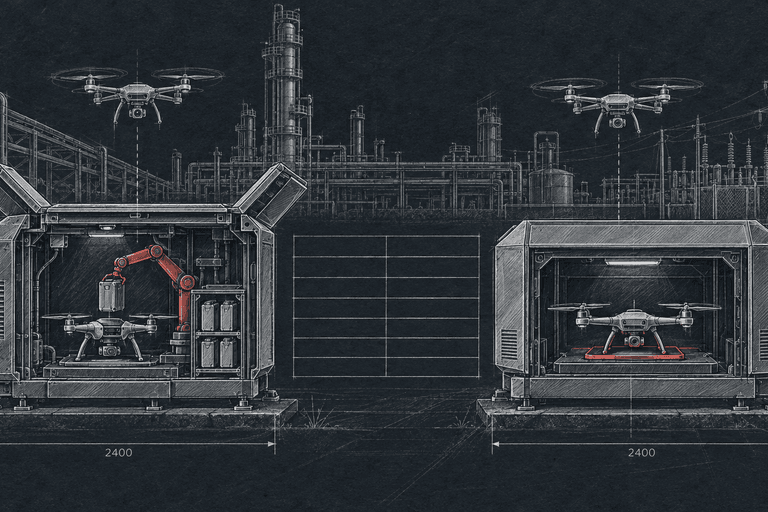
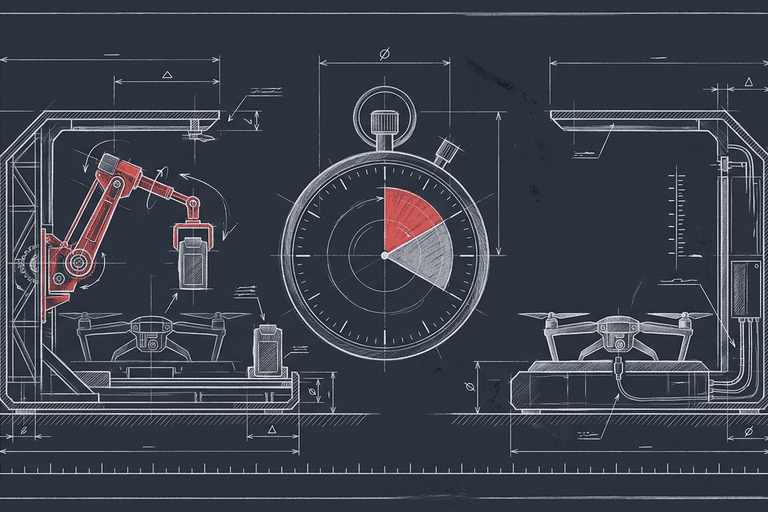
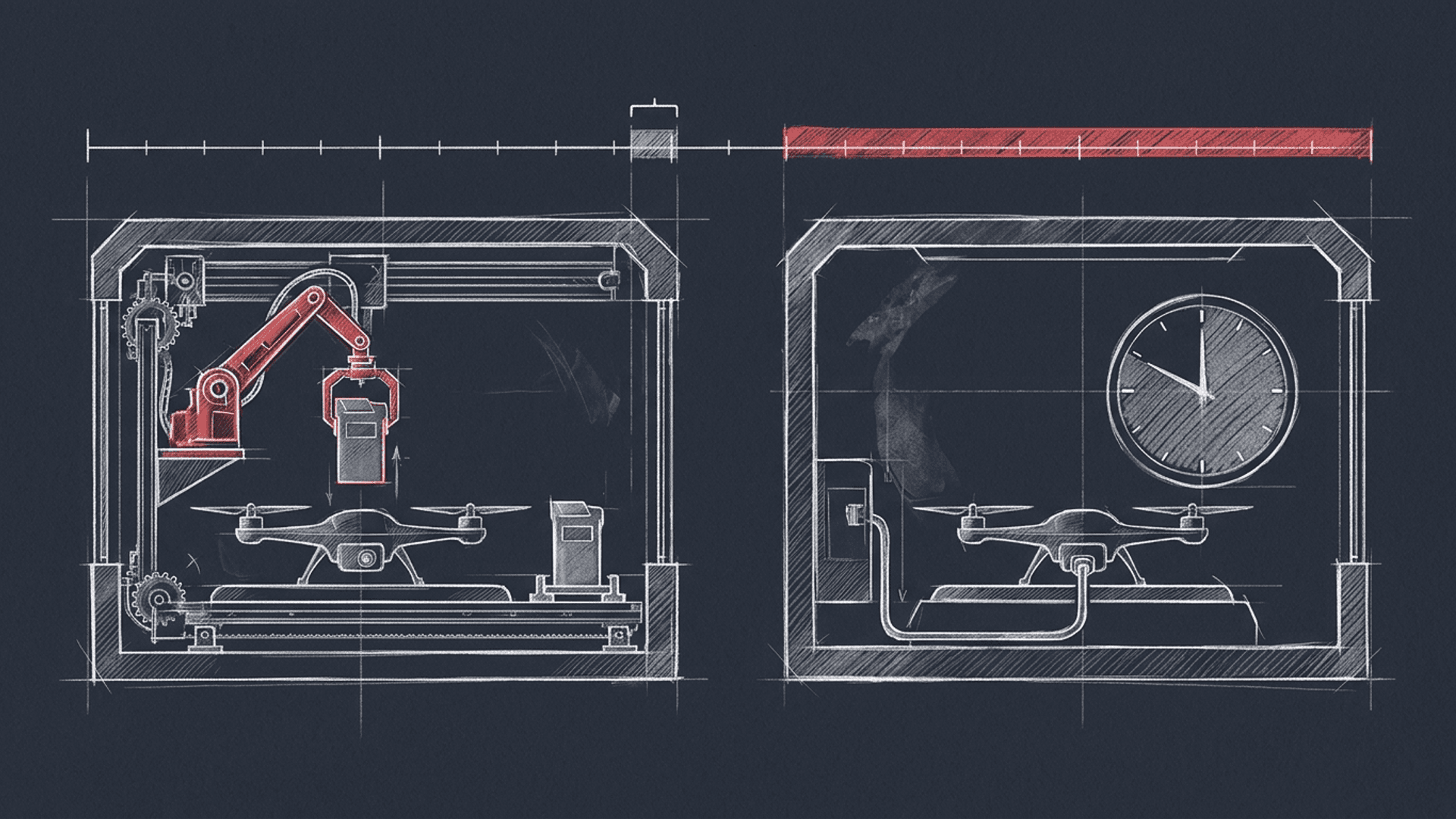
Dronehub's dock lands the drone, swaps the battery with a robotic mechanism and stages the aircraft for the next mission; the used pack recharges inside the enclosure while the drone flies. Skydio's Dock for X10 charges the aircraft itself: its FAQ gives about 35 minutes from 15% to 95% at 25 °C and says the time "may extend to a maximum of 73 minutes due to heating or cooling" in extreme temperatures.
Docks that charge in place publish roughly 20 to 35 minutes, so Skydio sits at the slow end of that range. With 25-minute missions flown back to back for 24 hours, an assumption rather than a vendor figure, a two-minute swap allows at most 53 sorties against 24 to 32 for a charging dock: close to twice the sorties. The full arithmetic is in robotic battery swap vs in-station charging.
Three caveats keep that fair:
- Mission length. The X10 is listed at up to 40 minutes of flight time. The longer each mission, the smaller the share of the day spent on the pad, and the smaller the gap.
- Mechanical complexity. Charging has fewer moving parts and needs no battery inventory. A swap dock adds a mechanism that must work through ice and snow, and packs to maintain.
- Cadence. For a few scheduled inspections a day, a 35-minute charge costs you nothing. The swap earns its mechanics on perimeter patrols, alarm response and back-to-back corridor sweeps.
Which dock handles harsher environments?
Skydio publishes more environmental detail. Its Dock for X10 is rated IP56, operates from −20 °C to 50 °C, launches and lands in winds up to 12 m/s, and is rated for rain of 4 inches an hour while on standby (the X10 itself flies in up to 0.25 inches an hour). Skydio also says it withstands winds up to 160 km/h when bolted down.
Dronehub's dock operates from −20 °C to +45 °C, so Skydio's hot-end ceiling is 5 °C higher. Dronehub's page describes a weatherproof outdoor enclosure with environmental conditioning, a satellite link and redundant power, but publishes no ingress-protection rating or wind figure for the dock; ask for the figures at your site's extremes before you decide.
Cold is where the architectures diverge. A charging dock must bring the battery to a safe charging temperature first, which is why Skydio's worst case is more than double its nominal figure. A swap dock keeps the next pack warm inside the enclosure, so the pack that goes into the drone is already conditioned.
What does the Skydio Dock for X10 battery setup look like?
This is a frequent search, so here is what Skydio publishes. Its price list sells a Skydio Dock Battery for X10 at $499 per spare, described as charging the X10 and "specially designed to work with the next generation of Skydio Dock". Each X10 dock bundle includes two. The dock page, FAQ and datasheet describe charging; none describes a battery exchange. The same price list makes the customer responsible for replacing propellers and batteries, even under the dock maintenance plan, though Skydio says it will try to do those swaps when its technicians are on site.
Dronehub's dock handles the pack itself: the robot removes the spent battery, inserts a charged one, and recharges the used pack inside the dock. Skydio's design is simpler and has fewer parts. Dronehub's is built to keep the aircraft flying.
Where does Skydio win?
Plainly, in four places.
- Blue UAS status. Skydio announced on 23 July 2026 that its X10, Dock for X10 and R10 joined the Blue UAS Cleared List. Dronehub's dock has no such listing. For a federal programme office that needs an already-listed item, this decides the question.
- US manufacturing. Skydio says it designs, assembles and supports its products in the US. Dronehub's dock is made in Jasionka, Poland, with joint EU-US R&D.
- Installed base. Skydio says it passed 1,000 docks deployed to customers in July 2026, in their first year of commercial availability, and that its systems are trusted by every branch of the US military and serve more than 4,000 US agencies and organisations. That field experience, and the regulatory history behind it, is hard to replicate.
- Autonomy maturity. Skydio's obstacle avoidance and remote-operation stack have years of public-safety and utility use. Its published FAA waiver history goes back to 2023, when Dominion Energy and the New York Power Authority were approved for fully remote operations with Skydio Dock and Remote Ops and no flight crew on site.
What does procurement look like: Blue UAS, Section 848 and the FCC?
Three different things are easily confused, and Blue UAS vs NDAA vs FCC Covered List separates them. Blue UAS is a list of vetted items, managed by the Defense Contract Management Agency (DCMA) since 3 December 2025. Section 848 (10 U.S.C. 4871 note) restricts components from certain countries. The FCC rule is a separate equipment-authorisation regime.
Dronehub's dock is designed to comply with Section 848, built with no components from China, Russia or Iran, and Dronehub does not claim a Blue UAS listing for it. Listing is item-specific: a cleared drone does not clear its dock, so Skydio's announcement naming the Dock for X10 itself matters.
The FCC adds a US-market point. Since 22 December 2025, drones and UAS critical components produced outside the US have been on the FCC Covered List, so new models cannot get FCC equipment authorisation without an exemption. The FCC's list of critical components names ground control stations, communications systems and data transmission devices, the categories a dock's radios fall into. The exemptions run until 1 January 2028 for items on DCMA's Blue UAS Cleared List and for items that qualify as domestic end products under the Buy American standard; others need a conditional approval. Skydio's Blue UAS-cleared dock falls under the first exemption; for any dock produced outside the US, ask the vendor which exemption or earlier authorisation covers each radio.
How do the software and cloud differ?
Skydio's dock is operated through its own stack: pilots fly docked X10s over the browser-based Remote Flight Deck, Ops Center manages fleets of docks, and Skydio Cloud provides remote health monitoring. Skydio lists SOC 2 Type II and CJIS certification, and its price list describes Remote Ops as browser-based operation with unlimited hours and pilots. Remote flight beyond visual line of sight still needs an FAA waiver, which Skydio sells preparation packages for.
Dronehub's approach is edge-first. The drone's Nvidia compute classifies frames in flight, and only flagged frames go to Sentinel, Dronehub's in-house anomaly-detection platform, for review. Its page states that imagery, telemetry, detections and audit logs stay inside EU and US infrastructure. Whichever you shortlist, ask where flight logs and imagery are stored and who administers the cloud: Section 848 covers data handling as well as hardware.
What does a Skydio Dock cost?
Skydio's most detailed public prices come from a 2025 price list filed for a US cooperative purchasing contract (NCSA). These are list prices; contracted prices carry a 6% discount, and the list is dated February 2025.
System | Item | Public price |
|---|---|---|
Dronehub drone-in-a-box | System purchase or technology licence | On quote |
Skydio Dock for X10 | Dock only | $36,000 MSRP |
Skydio X10 dock bundle | Dock, radio, X10 with sensors, two dock batteries | $50,547 to $54,359 MSRP |
Skydio | Deployment of one site (up to 5 days on site) | $35,250 |
Skydio | Dock maintenance and repair, annual, parts included | $9,900 a year |
Skydio Remote Ops | Browser-based remote operation (term not stated) | $15,000 |
Skydio | Spare Dock Battery for X10 | $499 |
Skydio | FAA waiver-application packages | From $20,000 |
At MSRP, the first-year bill for one Blue UAS-cleared bundle site is $50,547 plus $35,250 deployment, $15,000 Remote Ops and $9,900 maintenance, or $110,697, and $130,697 with a $20,000 waiver package, before the contract discount, connectivity, staff and insurance. For the full breakdown across vendors, see what a drone-in-a-box costs in 2026. Dronehub does not publish a list price; a request with the asset, cadence, geography and funding source returns a technical fit and a quote.
Should you buy a finished dock or license the technology?
Skydio sells finished products and services: hardware, software terms, deployment and maintenance. Its public list contains no technology licence for third parties.
Dronehub offers both routes. You can buy the drone-in-a-box outright, with the dock, drone, robotic battery swap, AI stack and operator UI, or license the docking, autonomy and analytics technology to ship under your own brand and contracts. For an operator, that is a choice of risk and speed. For an OEM or integrator, it is the difference between reselling someone else's product and owning yours.
What if the mission needs more range than a dock?
Both vendors answer that with a different aircraft. Skydio unveiled the F10 Lightrunner fixed-wing drone and the MegaDock, which houses up to five aircraft, on 24 September 2026, with a 30-mile (48 km) flight radius; customer deployments begin in 2027 and no price is published.
Dronehub's answer is the S-2, a separate long-endurance hybrid VTOL aircraft: 35 kg maximum take-off weight, up to seven hours of endurance, up to 700 km of range, vertical launch from roughly 5×5 metres. The S-2 is not docked in the drone-in-a-box; it is a different platform for missions beyond what a dock-launched multirotor covers.
Which one should you choose?
Choose Skydio if:
- You buy for a US federal or defense programme and need an item already on the Blue UAS Cleared List.
- You want a product designed and assembled in the US, with more than 1,000 docks deployed by Skydio's own count and an established waiver history.
- Your cadence is a few scheduled flights a day, where a 35-minute charge costs you nothing.
- You prefer a vendor-run cloud and a finished software stack over owning the integration.
Choose Dronehub if:
- Turnaround decides coverage: perimeter patrols, alarm response or back-to-back corridor sweeps, where a two-minute swap gives close to twice the sorties.
- You operate through cold winters, where a charge-in-place dock stretches its turnaround.
- You want EU manufacture with joint EU-US R&D, a Section 848-compatible supply chain, and a data path inside EU and US infrastructure.
- You are an OEM or integrator who wants to license the technology and build under your own brand.
Tell us the asset, the cadence and the funding source and we will come back with a technical fit you can set against Skydio's list: request specs and pricing.
FAQ
- What is the best Skydio Dock alternative in 2026?
- For buyers who want a non-Chinese dock that is not Skydio's, Dronehub's drone-in-a-box is the alternative this guide compares: a robotic battery swap in about two minutes, an operating range of −20 °C to +45 °C, joint EU-US R&D with manufacture in Poland, and a choice of buying the system or licensing the technology. It is not a drop-in replacement for every buyer. If you must procure an item that is already on the Blue UAS Cleared List, Skydio's Dock for X10 is the one with that status today. If turnaround between flights, EU manufacture or a technology licence matter more, Dronehub is the better fit.
- How does Dronehub's turnaround compare with the Skydio Dock for X10?
- Dronehub's dock swaps the battery robotically in about two minutes, and the used pack recharges inside the dock while the next sortie flies. Skydio's Dock for X10 charges the aircraft in place: about 35 minutes from 15% to 95% at 25 °C, and up to 73 minutes in extreme temperatures, according to Skydio. Across docks that charge in place, which publish roughly 20 to 35 minutes, a two-minute swap gives close to twice the sorties over 24 hours of back-to-back 25-minute missions. The gap narrows when missions are long and wide when the site is cold.
- How much does a Skydio Dock cost?
- A 2025 Skydio price list filed for a US cooperative purchasing contract shows MSRPs of $36,000 for the Dock for X10 alone and $50,547 to $54,359 for a bundle with an X10 drone, a radio and two dock batteries. Deploying one site lists at $35,250, dock maintenance and repair at $9,900 a year, and Remote Ops software at $15,000, with the term not stated. Contracted prices on that list carry a 6% discount. Dronehub prices on quote and publishes no list price.
- Is the Skydio Dock for X10 on the Blue UAS list, and is Dronehub's dock?
- Skydio announced on 23 July 2026 that its X10, Dock for X10 and R10 had been added to the Blue UAS Cleared List, which the Defense Contract Management Agency has managed since 3 December 2025. Dronehub does not claim Blue UAS status. Its drone-in-a-box is designed to comply with NDAA Section 848 (10 U.S.C. 4871 note) and is built with no components from China, Russia or Iran, but Section 848 compatibility is a design and supply-chain statement, not a listing. Confirm any vendor's status on DCMA's public Blue List before you rely on it.
- How does the battery work in the Skydio Dock for X10?
- Skydio's published materials describe charging in the dock rather than a battery exchange. Its price list sells a Skydio Dock Battery for X10, described as charging the X10 and designed to work with the dock, at $499 per spare; each dock bundle includes two. The dock charges from 15% to 95% in about 35 minutes at 25 °C, and the X10 itself is listed at up to 40 minutes of flight time. Skydio's maintenance line makes the customer responsible for replacing propellers and batteries. Dronehub's dock takes the opposite approach, exchanging the pack robotically in about two minutes.
- Can I license a dock design instead of buying a finished dock?
- With Dronehub, yes: the drone-in-a-box is sold outright, and its docking, autonomy and analytics technology is also licensed to other drone companies that want to ship it under their own brand. Skydio's public price list itemises hardware, software terms and services for customers; it contains no technology licence for third parties. If you are an integrator or OEM that wants to own the product line, that is a structural difference. If you are an operator who wants a finished product with a vendor-run cloud, Skydio's model is the more direct route.