Key facts
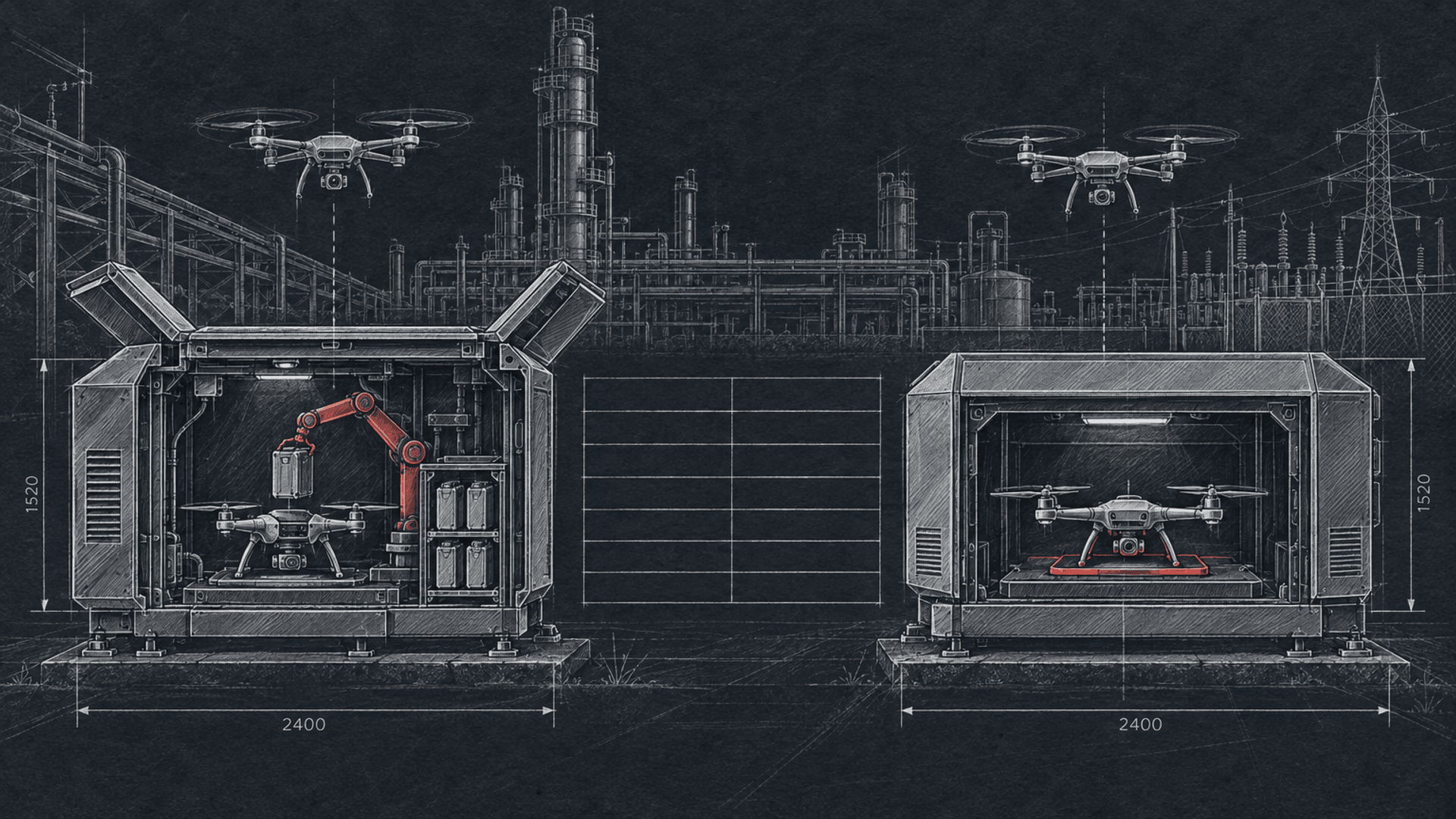
Dronehub's drone-in-a-box swaps the drone's battery robotically inside the dock in about two minutes and operates from -20 °C to +45 °C.
Source · Dronehub, Drone-in-a-Box dronehub.ai ↗
Percepto's pages say its station 'stores, charges and protects the drone between missions' and that a returning drone's 'battery life is restored'; they describe no battery swap and publish no charge time.
Source · Percepto, Harbor — https://percepto.com/harbor/ (the old Percepto Base address, https://percepto.com/drone-in-a-box/percepto-base/, now serves the same Harbor page; checked 29 October 2026)
Percepto's 2022 Air Max data sheet rates the Air Max drone IP55 and the Percepto Base IP56, and gives no operating temperature range.
Source · Percepto, Percepto Air data sheet (OP-3-01-4/2022) percepto.com ↗
5 more key facts
In May 2023 Percepto announced an FAA waiver for beyond-visual-line-of-sight operations in shielded airspace without humans on site, at infrastructure sites nationwide; in November 2023 it was reported to cover up to 30 drones flown simultaneously by one pilot.
Source · GPS World, 10 May 2023 — https://www.gpsworld.com/percepto-receives-faa-waiver-to-scale-shielded-bvlos-commercial-uas-operations/; Inside Unmanned Systems, 28 November 2023 insideunmannedsystems.com ↗
Percepto announced an FAA Type Certificate on 5 September 2024.
Source · DroneLife, 5 September 2024 dronelife.com ↗
On 7 April 2022 Percepto announced that the Dutch civil aviation authority (ILT) had approved its drones for BVLOS flight under the EU drone rules, and Germany's Luftfahrt-Bundesamt approved BVLOS operations for a Percepto client in April 2024.
Source · Percepto press release, 7 April 2022 — https://percepto.com/percepto-drones-receive-approval-to-fly-bvlos-under-new-european-regulation/; Unmanned Airspace, 11 April 2024 unmannedairspace.info ↗
On 27 October 2026 Percepto launched Axion, a hardware-agnostic software-as-a-service platform with more than 160 AI models trained on more than 100,000 hours of autonomous inspection data, and called itself a software-first company while saying its hardware remains a core part of the business.
Source · Percepto, press release 27 October 2026 — https://percepto.com/percepto-launches-hardware-agnostic-axion-platform-bringing-physical-ai-to-mission-critical-operations/; https://percepto.com/perceptos-next-chapter-a-software-first-physical-ai-company/
Percepto says the EPA approved its autonomous optical-gas-imaging drone system as an alternative test method under Subparts OOOOa and OOOOb, announced on 1 October 2025.
Source · Percepto press release, 1 October 2025 percepto.com ↗
In this piece
Dronehub's drone-in-a-box and Percepto's Air Max system (which Percepto's site now presents as the Ranger drone and Harbor station) both put an autonomous drone on an industrial site, but they differ in how the drone turns around, how the system is bought and where it is made. Dronehub swaps the drone's battery robotically in about two minutes, operates from -20 °C to +45 °C, is built in Poland with joint EU-US R&D, and is sold outright or licensed. Percepto's station charges the drone in place and publishes no charge time, but it brings the longer industrial track record, more regulatory approvals and a larger analytics suite.
Disclosure: this guide is published by Dronehub. Percepto figures come from Percepto's own pages, its press releases, a 2022 Percepto data sheet and trade-press reports of its approvals; where Percepto publishes no number, this guide says "not published". Dronehub figures come from dronehub.ai/drone-in-a-box. Data checked on 29 October 2026.
How do Dronehub and Percepto compare side by side?
System | Turnaround between flights | Temperature and weather | Compliance and origin | Software | How it is bought |
|---|---|---|---|---|---|
Dronehub drone-in-a-box | Robotic battery swap inside the dock, about 2 min | -20 to +45 °C; wind and IP ratings not on the product page | Section 848 compatible by design; Blue UAS not claimed; joint EU-US R&D, made in Poland, no components from China, Russia or Iran | Own AI stack (Sentinel); first-pass analysis on the drone's Nvidia computer | Buy outright, license the technology, or co-develop; on quote |
Percepto (Ranger drone + Harbor station; earlier Air Max + Base) | Charges in place; no swap described; charge time not published | Station "tested to withstand hurricane-5 winds" (no speed given); no temperature range published; 2022 data sheet: drone IP55, Base IP56 | Blue UAS and Section 848 status not stated; teams in the US and Israel; says it is consolidating manufacturing in the US | AIM cloud software; Axion analytics platform (from 27 Oct 2026) | Hardware price not published; Axion sold as software-as-a-service |
Both companies target the same buyers: energy and utilities, mining, oil and gas, ports and terminals, and perimeter security. For a wider market view, see our comparison of 18 drone-in-a-box systems and the cost guide.
Does the Percepto Base swap the battery or charge the drone?
It charges. Percepto's station pages say the unit "stores, charges and protects the drone between missions" and that when a drone is not in flight "it returns to a drone charging station where its battery life is restored". Neither the Harbor page nor the Percepto Base page describes a robotic battery swap, and neither gives a charge time, a battery capacity or a number of sorties per day. So the short answer to "Percepto base battery" is a charging base, with the turnaround time left unpublished.
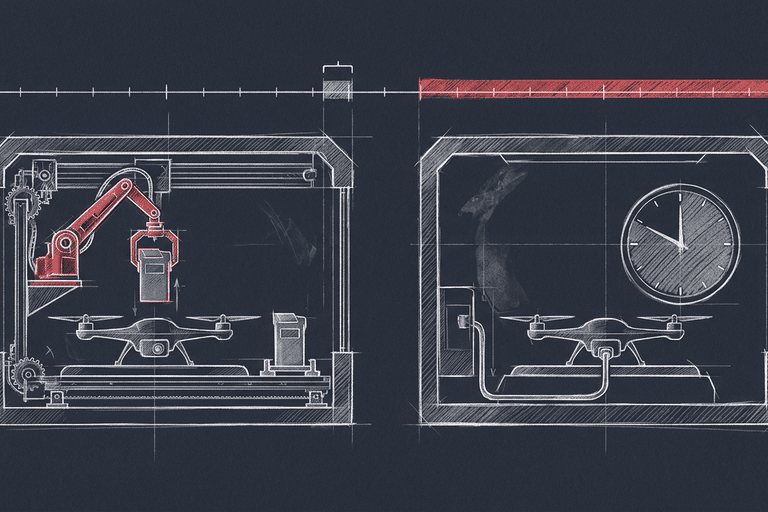
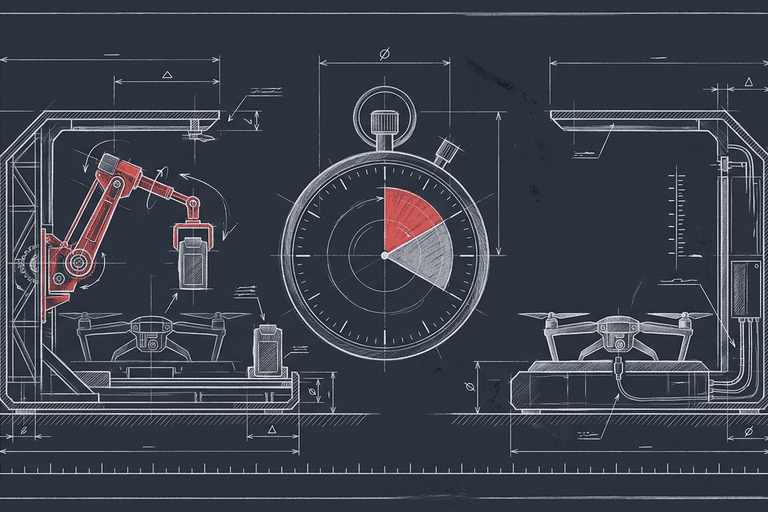
Dronehub's dock works the other way. A robot swaps the pack inside the dock in about two minutes and stages the aircraft for the next mission. Docks that publish charge-in-place times sit at roughly 20 to 35 minutes: DJI says Dock 3 charges from 15% to 95% in about 27 minutes at 25 °C, and Skydio's Dock for X10 takes about 35. On back-to-back missions a two-minute swap gives close to twice the sorties of a charging dock over 24 hours. Because Percepto has not published a charge time, that comparison cannot be calculated for its station, and you should ask for the figure at your site's coldest and hottest temperatures, since battery charging slows in extreme temperatures. The mechanics are covered in robotic battery swap vs in-station charging.
The trade-off runs both ways. A swap dock has more moving parts and a battery inventory to maintain. A charging dock is mechanically simpler, and for a few scheduled inspections a day the longer turnaround may cost you nothing.
One naming point. Percepto's current website presents a Ranger drone and a Harbor station, and its 27 October 2026 release names its hardware as the "Ranger drone portfolio and Harbor autonomous station". The old Air Max address, percepto.co/drone-in-a-box/air-max/, now redirects to percepto.com and serves the Ranger page, the old Percepto Base address serves the Harbor page, and one Harbor image still carries the alt text "Percepto Air Max Base tested against hurricane grade-5 winds". We found no Percepto statement that maps the old names to the new, so this guide treats Ranger and Harbor as the current hardware line and Air Max and Base as the earlier names, and the 2022 data sheet as the last published specification for the Air Max.
How do the two compare on weather and environmental range?
Dronehub states one operating range for its dock: -20 °C to +45 °C. Its product page does not state a wind limit or an ingress rating, so ask for both in the technical brief.
Percepto publishes a hurricane claim and little else. The Harbor page says the station is "tested to withstand hurricane-5 winds", with a "Hurricane Ready" badge reading "Tested & approved", but gives no wind speed and names no test body. Its general text says the Ranger can operate in "heavy rain, snow, high winds and dust" without numbers, and no operating temperature range appears on the pages we read. The only ratings Percepto has published as figures are in the 2022 data sheet: IP55 for the Air Max drone and IP56 for the Base.
For a site in a cold climate, a desert or a coastal storm zone, the practical step is the same for both vendors: ask for the temperature, wind and rain limits at which the dock will launch, land and charge or swap, and for the test report behind them.
Who has the better regulatory record and supply-chain position?
On approvals, Percepto is ahead, and this guide says so plainly. Its record, as Percepto and trade press report it:
- FAA: a nationwide waiver for shielded BVLOS operations without humans on site (May 2023); approval for one pilot to operate up to 30 drones (reported November 2023); and an FAA Type Certificate (announced September 2024).
- Europe: the Dutch aviation authority approved BVLOS flights in April 2022 under the EU drone rules, for the operator Falcker, whose first flights were planned for a tank terminal, and Germany's Luftfahrt-Bundesamt approved operations for a client in April 2024.
- Elsewhere: Transport Canada (January 2023, at an Ontario power station) and Australia's CASA (December 2021).
- Emissions: Percepto says the EPA accepted its autonomous gas-imaging drone system as an alternative test method (October 2025).
Each of these attaches to an operator, a site or a configuration, so none removes the need for a site-specific risk assessment. Dronehub does not claim a comparable approval portfolio.
On origin and procurement, the picture is different. Percepto describes its team as "based in the US and Israel"; its 2022 releases were datelined Modi'in, Israel and its 2025 and 2026 releases Austin, Texas, and on 27 October 2026 it said it is consolidating engineering, manufacturing and assembly in the United States. The pages we checked state neither a Blue UAS listing nor Section 848 compliance. Israeli origin is not itself an obstacle, because Section 848 concerns components from China; what a procurement office needs is the bill of materials, which Percepto does not publish. Blue UAS has been run by the Defense Contract Management Agency since 3 December 2025, and its list is where to verify any claim. Dronehub runs joint EU-US R&D, builds in its own factory in Jasionka, Poland, uses no components from China, Russia or Iran, is designed to comply with Section 848, and does not claim a Blue UAS listing. For the legal terms, see Blue UAS vs NDAA vs the FCC Covered List.
How do Percepto AIM and Axion compare with Dronehub's software?
Percepto's software layer is a core strength. Its AIM cloud software handles mission planning and remote operations, analyses visual, thermal and gas-imaging data, builds 3D models and volumetrics, and tags findings on a geospatial map. Percepto says AIM can orchestrate up to 30 drones from one interface. On 27 October 2026 it added Axion, a hardware-agnostic platform that ingests data from supported third-party drones, fixed and mobile sensors and old inspection archives, with more than 160 AI models trained on more than 100,000 hours of autonomous inspection data. Percepto has not published Axion pricing or the list of supported drones.
Dronehub's stack is narrower and built around the dock. First-pass classification runs on the drone's Nvidia computer, and only flagged frames go to Sentinel, Dronehub's in-house anomaly-detection platform; imagery and logs stay on EU and US infrastructure. Dronehub's production reference is rail inspection with Deutsche Bahn on Germany's 33,000 km network, a different sector from the heavy industry where Percepto's deployments are concentrated. It does not publish a model count or an equivalent to Percepto's emissions-compliance approval.
If your inspection programme is mostly about analytics across a mixed fleet of sensors, Percepto's software is the more complete offer. If it is about keeping a drone airborne around the clock with data that stays under US and EU control, the dock and data path are the differentiators.
Where does Percepto win?
- Installed base in heavy industry. Percepto's releases name Florida Power & Light (a 13-unit first phase announced in 2022), Chevron (two systems by March 2025) and Falcker, the Dutch operator approved in 2022. A 2021 Frost & Sullivan release said Percepto had the highest number of drone-in-a-box deployments, though neither it nor Percepto publishes a count. We do not claim Dronehub has more sites than Percepto.
- Regulatory approvals. The list above is long and spans the US, Europe, Canada and Australia.
- Analytics. AIM and Axion cover more inspection types, and the emissions work has a regulatory acceptance behind it.
How is each one bought: purchase or licence?
Dronehub sells the drone-in-a-box outright and also licenses its technology to other drone companies, which can build the dock under their own brand; a co-development route exists for mission-specific variants. Pricing is on quote.
Percepto sells to asset owners as hardware plus software, and describes combining "Percepto AIM software and Percepto Air drones with regulatory approvals and turnkey service support". We found no Percepto offer to license its dock design, and it publishes no hardware price. The 2026 pivot adds a pure-software option in Axion. For a buyer, the questions to put to Percepto are which hardware generation you would receive and how long it will be supported. For a drone maker that needs a dock instead of a whole system, licensing is where the two vendors differ most. Price anchors across the category are in the cost guide.
What if your site has long pipeline or conveyor corridors?
A dock covers a radius around itself; Dronehub's product page quotes about 20 km of mission coverage per drone per mission. A long pipeline, conveyor or transmission corridor can outrun a chain of docks. For that case Dronehub's separate S-2 is a long-endurance hybrid VTOL: 35 kg maximum take-off weight, up to 7 hours aloft, up to 700 km, launching vertically from roughly 5×5 m. It is a different aircraft that flies from a small launch patch; it does not dock in the drone-in-a-box. The same corridor logic applies to Percepto's multi-base approach, which lists "base hopping" for one drone across several stations.
Which one should you choose?
Choose Percepto if:
- you want the vendor with the longest industrial record in energy, mining and oil and gas, and need FAA and European approvals already in hand;
- your priority is analytics across many sensor types, or EPA-recognised gas imaging;
- you are comfortable with a charging-based turnaround and want a supplied, supported system.
Choose Dronehub if:
- you need a much shorter turnaround between flights than a charging dock gives, a robotic swap in about two minutes, for alarm response, perimeter or back-to-back corridor missions;
- you need a joint EU-US R&D vendor with a European factory, a stated Section 848 design basis and no components from China, Russia or Iran;
- you are a drone company that wants to license a dock rather than buy one, or an operator that wants to buy a dock and keep its data path under US and EU control.
Hazardous-area rules apply to either dock on a refinery; see the refinery drone inspection checklist and our energy sector overview.
Scoping a site? Tell us the asset, the cadence and the funding source and we will come back with a technical fit: request specs and pricing. More on the dock itself: Dronehub drone-in-a-box.
FAQ
- What is the best alternative to Percepto's drone-in-a-box?
- It depends on what you are replacing. Dronehub's drone-in-a-box is the alternative to look at if you need a robotic battery swap in about two minutes, a joint EU-US R&D vendor that manufactures in Poland with no components from China, Russia or Iran, and the option to license the technology rather than only buy a system. Percepto remains the stronger choice if you want a vendor with a long record in heavy industry, FAA and European approvals already in hand, and a large analytics suite. Other charge-in-place or swap docks, including Skydio, Ondas Optimus and Hextronics, are compared in our systems guide.
- Does the Percepto Base swap batteries or charge the drone?
- Percepto's own pages describe charging. They say the station 'stores, charges and protects the drone between missions' and that a returning drone's 'battery life is restored'. The pages describe no robotic battery swap, and Percepto publishes no charge time, so the turnaround between flights cannot be read from its documentation; ask for it at your site's temperature range. Dronehub's dock swaps the battery in about two minutes. Docks that publish charge-in-place figures, such as DJI Dock 3 at about 27 minutes and Skydio's Dock for X10 at about 35, show the range a charging dock typically sits in.
- Is the Percepto Air Max still sold, and what are the Ranger and Harbor?
- Percepto's current site (percepto.com) presents a Ranger drone and a Harbor station, and its 27 October 2026 release names its hardware as the Ranger drone portfolio and the Harbor autonomous station. The old Air Max product address now serves the Ranger page and the old Percepto Base address the Harbor page; one Harbor image still carries the alt text 'Percepto Air Max Base tested against hurricane grade-5 winds'. Percepto's June 2026 release also refers to Percepto Air drones. Percepto has not, on the pages we checked, published a statement mapping old names to new, so confirm with the vendor which hardware you would receive. On 27 October 2026 Percepto said its hardware remains a core part of its business while it becomes a software-first company.
- Is Percepto Blue UAS listed or NDAA compliant?
- The Percepto pages we checked on 29 October 2026 state neither a Blue UAS listing nor Section 848 compliance, and they do not publish a bill of materials, so ask for both in writing. Blue UAS has been run by the Defense Contract Management Agency since 3 December 2025, and its public list is the place to verify any vendor. Section 848 concerns components from China, so Percepto's Israeli origin is not itself the question; the parts are. Dronehub states that its dock is designed to comply with Section 848, with no components from China, Russia or Iran, and does not claim a Blue UAS listing.
- Which regulatory approvals does Percepto hold?
- Percepto reports an FAA nationwide waiver for shielded BVLOS operations without humans on site (May 2023), approval for one pilot to operate up to 30 drones (reported November 2023) and an FAA Type Certificate (announced September 2024). In Europe, the Dutch authority approved its BVLOS flights in April 2022 and Germany's Luftfahrt-Bundesamt approved operations for a client in April 2024; Transport Canada and Australia's CASA also issued approvals. Each approval is tied to an operator, a site or a set of operating conditions, so a new site still needs its own risk assessment. Dronehub does not claim a comparable approval portfolio.
- Can I license Percepto's dock technology the way I can license Dronehub's?
- Dronehub sells its drone-in-a-box outright and also licenses the technology to other drone companies, who can build the dock under their own brand. Percepto's pages describe hardware and software offered as products and services: AIM for operations and, since 27 October 2026, Axion as a software-as-a-service platform. We found no Percepto offer to license its dock design to third parties, and neither company publishes prices for the hardware. If you are a drone maker that needs a dock, licensing is a Dronehub option; if you are an asset owner that wants a supplied, supported system, both vendors sell one.