Key facts
Under EU Directive 1999/92/EC, Zone 0 is where an explosive gas atmosphere is present continuously, for long periods or frequently, Zone 1 where it is likely to occur occasionally in normal operation, and Zone 2 where it is not likely and short-lived; Zone 1 requires category 1 or 2 equipment, Zone 2 category 1, 2 or 3.
Source · EUR-Lex, Directive 1999/92/EC, Annexes I and II eur-lex.europa.eu ↗
ANYbotics' ANYmal X legged inspection robot is approved under the IECEx and ATEX certification standards for use in Zone 1 explosive atmospheres, and carries gas sensors for methane, carbon monoxide and hydrogen sulphide.
Source · ANYbotics, ANYmal X announcement (22 March 2022) anybotics.com ↗
API 653 (clause 6.3.2.1) requires every tank in its scope to receive a visual external inspection by an authorized inspector at least every five years, or sooner (RCA/4N years) where the shell corrosion rate demands it, and the tank may stay in operation during that inspection.
Source · API 653, 3rd edition with Addendum 1 (2003), clause 6.3.2.1, public mirror law.resource.org ↗
3 more key facts
The Energy Institute published EI 3624 in April 2026: good-practice guidance for visual inspection with unmanned aerial vehicles, covering the inspection stages common to high-hazard assets, equipment choice, and managing and evaluating UAV inspections.
Source · Energy Institute, EI 3624 Remote visual inspection volume 2 energyinst.org ↗
The FAA's proposed Section 2209 rule (NPRM published 6 May 2026; not final as of late September 2026) would let refineries that convert crude oil and can produce 100,000 barrels per day or more apply for an unmanned aircraft flight restriction over their site.
Source · Federal Register, 2026-08943, Designation-Restrict the Operation of Unmanned Aircraft in Close Proximity to a Fixed Site Facility federalregister.gov ↗
The EU Methane Regulation (EU) 2024/1787 covers oil and gas production, gas transmission and distribution, underground storage and LNG facilities, but not refineries; its recitals note that methane from refining is covered by the Industrial Emissions Directive 2010/75/EU.
Source · EUR-Lex, Regulation (EU) 2024/1787, recital 7 and Article 1 eur-lex.europa.eu ↗
In this piece
Before a drone flies inside a refinery fence, confirm six things: the hazardous-area classification of every zone on the route and whether the aircraft is certified for it (most are not), a site permit-to-work, an aviation approval, a payload matched to each asset, an emergency plan, and a data path that respects the site's security rules. The checklist below walks through each, then goes asset by asset — flare stacks, tanks, columns, piping, pipelines and the fence line — and ends with who supplies which piece.
Disclosure: Dronehub builds drone-in-a-box infrastructure for fixed-site inspection, including at energy and industrial sites. This checklist is vendor-neutral; we name our own product only where it is relevant and say so.
The checklist at a glance
# | Check | Why it matters | Evidence to keep |
|---|---|---|---|
1 | Overlay every route on the site's hazardous-area drawings | A drone without Ex certification is a potential ignition source | Zone drawing with routes and exclusion areas |
2 | Match aircraft, dock and payload to each zone crossed | Zone 1 needs category 1 or 2 equipment, Zone 2 category 1, 2 or 3 | Certificates, or a documented exclusion |
3 | Run flights under the permit-to-work system | Gas testing, simultaneous operations, abort criteria | Signed permits, gas-test records |
4 | Hold the right aviation approval | EU specific category for BVLOS; US Part 107 plus waivers | Authorisation or waiver on file |
5 | Check airspace and flight restrictions | Refineries can sit near airports; FAA Section 2209 rule proposed | Airspace check per flight |
6 | Coordinate radio frequencies | Drone links share spectrum with plant radios and instruments | Frequency plan agreed with the site |
7 | Plan flare and heat standoffs | Radiant heat and plume affect aircraft and sensors | Standoff distances per flare |
8 | Define the confined-space workflow | Internal tank and vessel work stays permit work | Isolation and entry permits |
9 | Choose gas-detection payloads per unit | OGI, laser absorption and point sensors see different gases | Payload specification |
10 | Write emergency procedures | Lost link, crash inside a unit, fire | Procedures in the operations manual |
11 | Secure the imagery | Refinery imagery is security-sensitive | Access control, hosting location, retention |
12 | Feed findings into inspection records | Findings must reach the API 510/570/653 and RBI programmes | Findings tied to equipment tags |
Hazardous areas come first
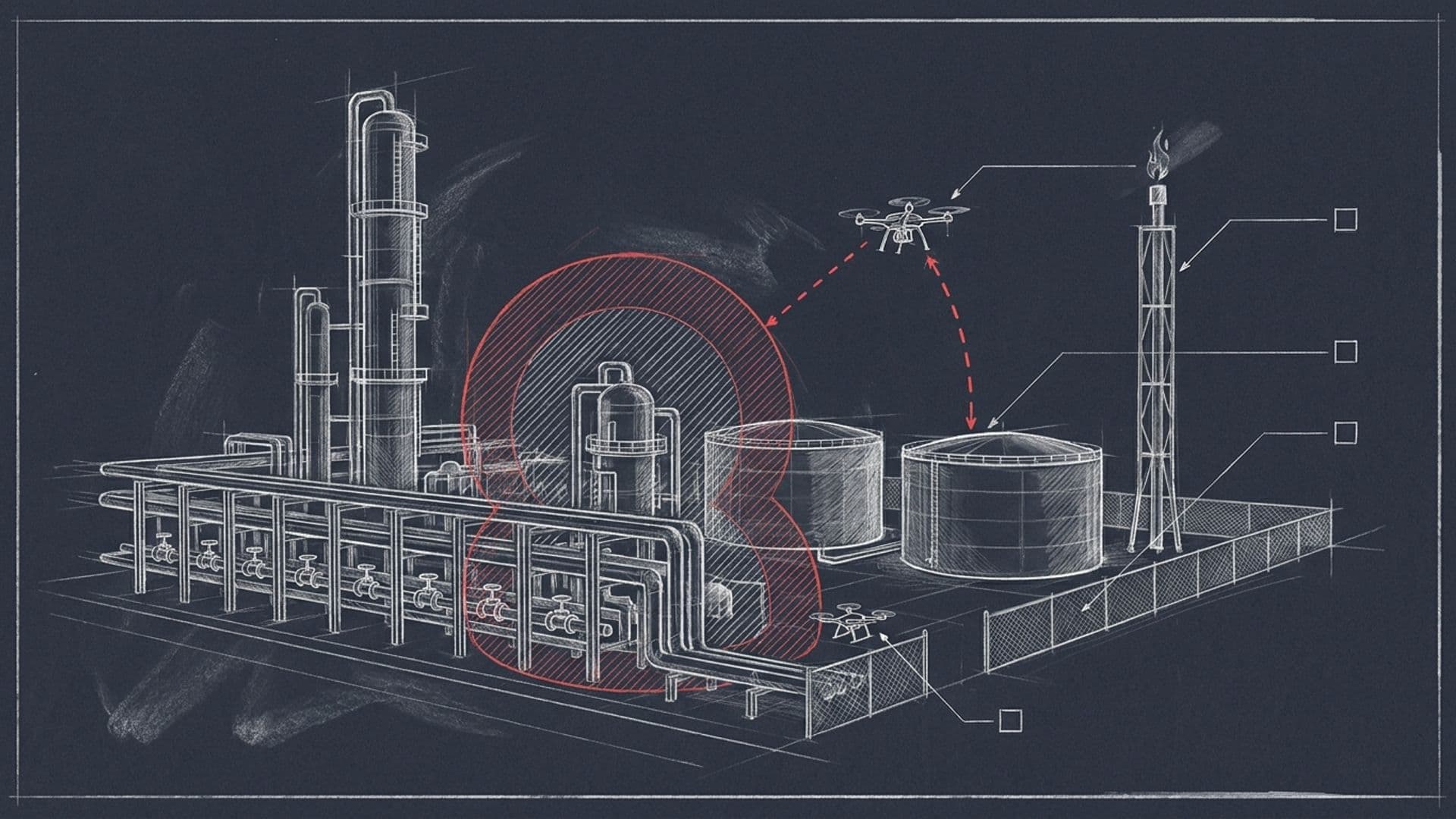
Directive 1999/92/EC makes the site classify its areas: Zone 0 where an explosive gas atmosphere is present continuously, for long periods or frequently, Zone 1 where it is likely to occur occasionally in normal operation, and Zone 2 where it is not likely and would be short-lived. It then sets which equipment category may be used — category 1 or 2 in Zone 1, category 1, 2 or 3 in Zone 2. Directive 2014/34/EU governs the certification of that equipment. US facilities classify locations under the National Electrical Code, for example as Class I, Division 1 or 2 — Division 1 where ignitable concentrations may exist in normal operation, Division 2 where they would appear only through an accident or unusual condition.
Ex-certified aircraft remain rare. When trade press covered Xamen's LE 4-8X in 2016, it was approved for Zone 2, with a Zone 1 version still in development. That leaves three workable patterns:
- Fly outside classified areas, observing zones from a standoff with zoom and thermal payloads. This covers most external inspection.
- Treat any entry into a zone as ignition-source work under the permit-to-work system: gas testing, continuous monitoring, a defined abort criterion.
- Use Ex-certified ground robots for routine rounds inside Zone 1. ANYbotics' ANYmal X is approved under IECEx and ATEX for Zone 1, and ExRobotics' ExR-2 robot and its docking station carry ATEX and IECEx Zone 1 certificates.
The same logic applies to docks. A drone-in-a-box is electrical equipment: site it outside classified zones unless it carries an Ex certification for the zone in question.
Permits and approvals
Aviation. In the EU, beyond-visual-line-of-sight (BVLOS) inspection needs the specific category under Regulation (EU) 2019/947, with a SORA-based authorisation; line-of-sight work fits the open category only if all its limits can be met. In the US, Part 107 applies and BVLOS needs a waiver; the proposed Part 108 is still pending. Refineries can sit close to airports and inside controlled airspace, so check the airspace for every route.
Flight restrictions. The FAA's proposed Section 2209 rule, published on 6 May 2026 and not yet final, would let refineries that convert crude oil and can produce 100,000 barrels per day or more apply for an unmanned aircraft flight restriction over their site. As drafted, even certificated Part 107 flights could only transit such an area unless the FAA authorises otherwise — so a refinery that applies should plan how its own inspection flights will be authorised.
Site permits. Drone flights inside the fence belong in the permit-to-work system like any other work: simultaneous-operations checks with operations and maintenance, notification to the control room, radio-frequency coordination, and a recovery plan if the aircraft comes down inside a unit.
Industry guidance. Two documents are worth adopting as the baseline: the Energy Institute's EI 3624 (April 2026), good-practice guidance for UAV visual inspection of high-hazard assets, and IOGP's Report 696 on managing remotely piloted aircraft operations, whether run directly or through contractors.
Asset by asset
Asset | What to capture | Payload | Governing practice | Note |
|---|---|---|---|---|
Flare stacks | Tip, pilots, supporting steelwork | Zoom RGB, thermal | Site flare-inspection plan | Can be flown with the flare in service, at a planned standoff |
Storage tanks, external | Shell, roof, seals, wind girders, coatings | RGB, thermal, LiDAR | API 653 | Supports the authorized inspector |
Storage tanks, internal | Floor, shell, roof underside | Confined-space drone | API 653; confined-space rules | Tank still isolated and made safe |
Columns and pressure vessels | Insulation, nozzles, platforms, coatings | Zoom RGB, thermal | API 510 | High elevations without scaffolding |
Piping and pipe racks | Supports, insulation damage, leaks | RGB, thermal, OGI | API 570 | Tie findings to line numbers |
Pipelines and right-of-way | Encroachment, excavation, leaks | RGB, thermal, gas sensors | US: 49 CFR 195.412 | PHMSA accepts drones for patrols |
Structures needing thickness data | Wall thickness at height | Contact drone with ultrasonic probe | Site NDT procedures | Avoids rope access |
Fence line and perimeter | Fence condition, intrusion | RGB, thermal | Site security plan | Good fit for scheduled dock flights |
Flare stacks are the classic drone job. Cyberhawk, an inspection service firm, inspects onshore stacks and offshore flares by drone without scaffolding, and uses thermal cameras to highlight overloads, insulation failures and leaks. The biggest gain is timing: when Cyberhawk inspected a live flare stack at a Scottish refinery in 2011, knowing its condition before the shutdown let the client scope the repairs and order long-lead spare parts in advance.
Tanks are driven by API 653, which requires a visual external inspection by an authorized inspector at least every five years, or sooner where corrosion demands it, with the tank allowed to stay in service. A drone gives that inspector the roof and upper shell without a climb. Internal work is different: Flyability's Elios 3 is designed for visual and thermal inspection inside confined spaces with no human entry, but the space is still a permit-required confined space under rules such as OSHA 1910.146 until it has been made safe.
Contact inspection fills the gap where a picture is not enough. Voliro's Voliro T applies up to 30 N of stable force for drone-based non-destructive testing, including on assets in service.
Pipelines leaving the fence have a clear US answer: PHMSA's interpretation says the right-of-way patrols required by § 195.412(a) — at least 26 a year — may use drones if the images have enough resolution to show surface conditions.
Gas detection payloads
Technology | What it measures | Strengths | Limits | Examples |
|---|---|---|---|---|
Optical gas imaging (OGI) | Visualises hydrocarbon plumes | Many gases, shows the source | Needs thermal contrast between gas and background | Teledyne FLIR AerialOGI-N: 25+ gases incl. methane and VOCs |
Laser absorption (TDLAS, cavity-enhanced) | Methane concentration along a path or in the plume | High sensitivity, quantification | Mostly methane-focused | Pergam Laser Falcon, SeekOps SeekIR, ABB HoverGuard |
Point sensors (H2S, flammable gas) | Local concentration at the aircraft or robot | Protects crews and equipment | Must fly through the plume | Sensors on ANYmal X and ExR-2 |
Regulatory acceptance is growing but source-specific. In the US, Percepto says the EPA approved its autonomous OGI drone system as an alternative test method under subparts OOOOa and OOOOb — rules for the oil and gas production and transmission chain rather than refineries. In the EU, the Methane Regulation (EU) 2024/1787 covers production, transmission, distribution, storage and LNG, while methane from refining falls under the Industrial Emissions Directive. Check which rule governs each unit before you buy a payload for compliance surveys.
Emergency procedures and radio coordination
Write these down before the first flight, not after the first incident:
- Lost link. Define the return route and the holding point for every mission, and make sure neither crosses a classified zone.
- Aircraft down inside a unit. Who is told, who may enter to recover it, and whether a battery fire in that area triggers the site's fire response.
- Plant alarms. A gas alarm, a flaring event or an emergency shutdown should end the flight automatically or by instruction from the control room.
- Radio. Plant wireless instruments, handheld radios and drone command-and-control links can share spectrum. Agree a frequency plan with the site's telecom team and test it before routine flights.
- Weather and flare state. Set wind limits per asset, and a rule for what happens when a flare's heat load changes mid-mission.
Operating models
Most refineries combine three:
- Campaign inspections by specialist contractors, timed around turnarounds — flares, tank internals, columns.
- Persistent docked drones for recurring work: flare monitoring, tank-farm thermal surveys, fence-line patrols, leak surveys and post-incident look-sees at night.
- Ex-certified ground robots for routine operator rounds inside Zone 1.
Dronehub works in the second model. Our energy and critical-infrastructure pages list refinery flare-stack monitoring, tank-farm thermal surveys, fence-line condition and leak detection with thermal and visible-spectrum imaging among the jobs for our drone-in-a-box. The dock re-arms the aircraft with a two-minute robotic battery swap, is designed for 24/7 operation and an operating range of −20 to +45 °C, and keeps imagery on EU and US infrastructure. On why the swap matters for repeated flights per shift, see battery swap versus in-station charging.
Who supplies what
Companies are listed by what each describes on its own website and grouped by role; this is not a ranking.
Company | Type | Relevant capability |
|---|---|---|
Drone-in-a-box and AI software | Autonomous OGI and site inspections for oil and gas, including refineries; EPA alternative-test-method approval, per Percepto | |
Skydio (US) | Drone and dock | Dock for X10, on the Blue UAS Cleared List since July 2026 |
Dock software | Dock-agnostic automation and AI agents for oil and gas operations | |
Flyability (Switzerland) | Confined-space drone | Elios 3 for confined spaces such as tanks and vessels |
Contact-inspection drone | Contact-based non-destructive testing at height, including assets in service | |
Cyberhawk (UK, part of Ondas) | Inspection services | Flares, stacks and vessels, onshore and offshore |
ANYbotics (Switzerland) | Ex-certified legged robot | ANYmal X for Zone 1 rounds |
Ex-certified ground robot | ExR-2 robot and docking station certified for Zone 1 | |
Dronehub (US / Poland) | Drone-in-a-box and AI | Persistent flare, tank-farm and fence-line monitoring — our own product |
Data handling
Refinery imagery shows the layout, the security measures and the weak points of a facility that governments treat as critical infrastructure. Decide where the imagery is hosted and who can access it before the first flight, keep an audit trail, and delete raw footage once the findings are recorded. Findings are only useful when they land in the inspection programme: tag each one to an equipment number, attach it to the API 510, 570 or 653 record, and let the risk-based inspection plan decide what happens next. Our note on edge and cloud inference covers keeping processing close to the aircraft.
Where to start
Start outside the classified areas with the jobs that currently need scaffolding, rope access or a shutdown: flare tips, tank roofs, column tops. Measure each against the method it replaces — time, cost, access risk and the quality of the finding — and bring the permit-to-work owner into the first flights rather than the last. Move to docked, recurring flights only once the routes, permits and data path are proven, and use ground robots where the work sits inside Zone 1.
For a wider view of the energy sector, read energy grid and AI inspection; to scope a refinery deployment, talk to us.
FAQ
- Can drones fly in ATEX zones at a refinery?
- Only with equipment certified for the zone, or under a permit that makes the area safe first. EU Directive 1999/92/EC requires category 1 or 2 equipment in Zone 1 and category 1, 2 or 3 in Zone 2, and most inspection drones carry no Ex certification at all. In practice refineries fly drones in unclassified areas and at a standoff from classified ones, treat any flight into a zone as ignition-source work under the permit-to-work system with gas testing, and use Ex-certified ground robots such as ANYmal X or ExR-2 for routine rounds inside Zone 1.
- How are flare stacks inspected with drones?
- Often while the flare stays in service. A drone holds a planned standoff from the tip and captures zoom and thermal imagery of the tip and its supporting structure, without scaffolding or a crane. Inspecting before a turnaround lets the site scope repairs and order long-lead parts in advance — the benefit Cyberhawk reported from a live flare inspection at a Scottish refinery in 2011. Plan the standoff around radiant heat and the plume, and fly only in wind conditions agreed with operations.
- Can drones inspect the inside of storage tanks?
- Yes, with confined-space drones such as Flyability's Elios 3, which is designed for visual and thermal inspection inside confined spaces with no human entry. The drone reduces the number of entries but not the preparation: the tank still has to be isolated and made safe, because standard inspection drones are not Ex-certified, and the internal inspection still has to satisfy API 653 and the site's confined-space rules, such as OSHA 1910.146 in the US.
- What permits are needed for drone inspection at a refinery?
- Three layers. An aviation approval: in the EU usually a specific-category authorisation, in the US Part 107 plus a waiver for flights beyond visual line of sight. A site permit-to-work that covers hazardous-area rules, simultaneous operations and radio use. And, in the US, a check for flight restrictions: the FAA's proposed Section 2209 rule would let large refineries request an unmanned aircraft flight restriction over their site, so a refinery that applies should plan how its own inspection flights will be authorised.
- Which drone payloads detect gas leaks at refineries?
- Optical gas imaging (OGI) cameras visualise hydrocarbon plumes — Teledyne FLIR's AerialOGI-N module, for example, detects more than 25 gases including methane and VOCs from a drone gimbal. Laser absorption sensors (TDLAS and cavity-enhanced variants from Pergam, SeekOps and ABB) measure methane concentration precisely but mostly target methane. Point sensors for H2S and flammable gas protect the crew and the aircraft. Match the payload to the gases your units actually emit.
- Which companies offer autonomous drone inspection for oil refineries and petrochemical plants?
- Dock-based autonomy comes from Percepto, Skydio (Dock for X10) and drone-in-a-box makers including Dronehub, with FlytBase as dock-agnostic software. Specialist inspection comes from Flyability (confined spaces), Voliro (contact-based testing) and service firms such as Cyberhawk (flares). Inside Zone 1 areas, autonomous rounds today mostly rely on Ex-certified ground robots such as ANYbotics' ANYmal X and ExRobotics' ExR-2.