Key facts
NERC standard FAC-003-5 requires applicable transmission owners to inspect vegetation on 100% of their applicable transmission lines at least once per calendar year, with no more than 18 calendar months between inspections on the same right-of-way.
Source · NERC, FAC-003-5 Transmission Vegetation Management, Requirement R6 nerc.com ↗
The FAA's proposed Part 108 BVLOS rule (NPRM of 7 August 2025; no final rule published as of late September 2026) would treat airspace within 50 feet of power lines and substations as a shielded area when the owner gives permission, citing electric and magnetic fields that require minimum drone standoff distances.
Source · Federal Register, 90 FR 38212, proposed § 108.205 federalregister.gov ↗
On 22 December 2025 the FCC added uncrewed aircraft systems and UAS critical components produced in foreign countries to its Covered List, which bars new models from FCC equipment authorization; the FCC says previously authorized models can still be imported, sold and used, and items on DCMA's Blue UAS Cleared List or qualifying as domestic end products under the Buy American Standard are exempt until 1 January 2028.
Source · FCC Public Notice DA 25-1086 — https://docs.fcc.gov/public/attachments/DA-25-1086A1.pdf ; FCC, Covered List FAQs: UAS and UAS Critical Components fcc.gov ↗
3 more key facts
The EU AI Act lists AI systems intended as safety components in the supply of electricity as high-risk (Annex III, point 2); after Regulation (EU) 2026/1744, the high-risk obligations for Annex III systems apply from 2 December 2027.
Source · EUR-Lex, Regulation (EU) 2024/1689 Annex III — https://eur-lex.europa.eu/legal-content/EN/TXT/?uri=CELEX:32024R1689 ; Regulation (EU) 2026/1744 amending Article 113 eur-lex.europa.eu ↗
Scopito publishes per-asset prices for power-line image analysis: €40 per transmission pylon and €16 per distribution pole with its linemen reviewing the imagery, or €20 and €10 for customers doing their own analysis.
Source · Scopito, power line inspection software pricing scopito.com ↗
Elia Group, which operates about 19,000 km of high-voltage lines in Belgium and Germany, runs a BVLOS drone project testing whether autonomous drones can replace helicopter inspections over distances of 100–200 km, and estimates its helicopter inspections cost over €200,000 a year.
Source · Elia Group innovation, From conventional to digital power line inspections innovation.eliagroup.eu ↗
In this piece
The best AI power-line and substation inspection setup depends on which layer you are buying. Drones and docks capture the imagery — drone-in-a-box makers such as Dronehub, and Skydio, Percepto and DJI. Analytics software turns imagery into defect lists — for example eSmart Systems, Buzz Solutions, Sharper Shape, Hepta Insights and Scopito. Contact drones such as Voliro's add measurements a camera cannot take. Most utilities combine one tool from each layer. Below: ten options compared on six criteria, a side-by-side table, the rules that shape the choice in the US and EU, and what pricing is actually public.
Disclosure: this guide is published by Dronehub.
How we compared
Six criteria, chosen because they decide whether a pilot turns into a programme:
- Scope — transmission lines, distribution, substations, vegetation, or all four.
- AI approach — pre-trained models, human review of findings, and whether you can train models on your own assets.
- Data sources — drone only, or also helicopter, fixed-wing LiDAR, satellite and ground photos.
- Deployment and integration — cloud or on-premise, and whether findings flow into GIS, maintenance and ERP systems as work orders.
- Autonomy and approvals — docks, remote operations, readiness for flights beyond visual line of sight (BVLOS).
- Supply chain and compliance — FCC Covered List and Blue UAS status in the US; data residency and the EU AI Act in Europe.
We also note where a price is published. Where it is not, the answer is "on quote".
Six approaches, side by side
Approach | How it works | Strengths | Limits | Best for |
|---|---|---|---|---|
Foot and ground patrol | Linemen walk or drive the line with binoculars and cameras | Expert judgement on site | Slow, limited view of tower tops | Local checks, training |
Helicopter survey | Camera, infrared and LiDAR from a crewed aircraft | Long distances per day | Cost, crew risk, low frequency | Network-wide surveys |
Piloted drone plus AI software | Crews fly towers within line of sight; software reviews images | Close-up detail, flexible | Crew hours per structure | Distribution, targeted transmission work |
BVLOS corridor drones | Long-range aircraft fly the corridor, monitored remotely | Helicopter-like coverage without a crew aboard | Approvals, command-and-control links | Transmission corridors |
Docked drones | Docks at substations or along segments fly scheduled or triggered missions | High frequency, fast response after storms | Dock siting, power, communications | Substations, critical segments |
Contact drones | Drone presses a probe against the structure | Measurements, not just pictures | Slow, specialist crews | Tower and component NDT |
Elia Group, which operates about 19,000 km of high-voltage lines in Belgium and Germany, describes the traditional mix well: foot patrols twice a year and helicopter surveys every one to three years with high-resolution, infrared and LiDAR sensors. Its BVLOS drone project is testing whether autonomous drones can replace those helicopter surveys over distances of 100–200 km.
The options, by layer
Capture: drones and docks
1. Dronehub — drone-in-a-box with Sentinel AI. Our drone-in-a-box re-arms the aircraft with a two-minute robotic battery swap and is designed for 24/7 operation, with first-pass classification on the drone's Nvidia compute and our in-house Sentinel AI reviewing flagged frames. Our energy page describes the two grid jobs: corridor sweeps for vegetation, conductors, insulators and hardware, and substation perimeter security with thermal and visible-spectrum condition monitoring. Imagery stays on EU and US infrastructure, and the supply chain has no components from China, Russia, Iran or sanctioned states. Best fit: operators that want to license or co-develop dock infrastructure. Price on quote.
2. Skydio — X10 and Dock for X10. Skydio announced in July 2026 that the X10, Dock for X10 and R10 had joined the X10D on the Blue UAS Cleared List. The dock pre-positions aircraft in networked, temperature-controlled stations, and Skydio positions it for utilities that inspect assets remotely and respond to emergencies. Best fit: US utilities that need Blue UAS-cleared hardware. Price on quote.
3. Percepto. Percepto's autonomous distribution-grid inspection combines AI software, docked drones and remote fleet operations, with use cases from overheating components and corrosion to vegetation and post-storm damage. Percepto says its drones are FAA-approved for nationwide BVLOS operations. Best fit: utility sites and distribution networks run with remote operations. Price on quote.
4. DJI — Dock 3 with Matrice 4D or 4TD. DJI Dock 3 supports 24/7 remote operations and vehicle-mounted deployment, and is sold through enterprise dealers. Third-party platforms such as FlytBase support it. In the US, the FCC's December 2025 Covered List action bars new foreign-produced drone models and critical components from FCC authorization (models authorized earlier can still be sold and used), so check what you can buy and keep supported before committing. Price through dealers.
Dock software. FlytBase automates docks from several makers, including DJI's, with an electric-utilities offering — useful if you want one operations layer across mixed hardware.
Analytics software
5. eSmart Systems — Grid Vision. Grid Vision runs AI-assisted virtual inspections of overhead lines and builds a digital asset inventory as it goes. eSmart's product brochure describes what it calls collaborative AI — the AI recommends defects and inspectors verify them — with more than 30 AI models for overhead-line defect detection. Best fit: utilities with large image backlogs and in-house inspectors. Price on quote.
6. Buzz Solutions — PowerAI. PowerAI covers transmission, distribution, substations and solar, with 50+ pre-trained models and thermal and RGB imagery analysed together for substations. Buzz says Dominion Energy runs it across all 47,000 of its transmission structures. Best fit: US utilities scaling visual AI across asset classes. Price on quote.
7. Sharper Shape — Sharper CORE. Dual-headquartered in Helsinki and Salt Lake City and working with utilities since 2013, Sharper Shape builds LiDAR-based "living digital twins" on a SaaS platform, backed by data-collection services, with AI for LiDAR segmentation and vegetation encroachment. Best fit: vegetation programmes and utilities that want capture and analytics from one supplier. Price on quote.
8. Hepta Insights. Hepta combines AI anomaly detection with review by grid experts, accepts drone, helicopter, LiDAR, satellite and ground-patrol data, and offers cloud or on-premise deployment. It says more than 30 distribution and transmission operators in 21 countries use it, inspecting over 3,000 km of line a month. Best fit: operators mixing data sources who want findings validated before they reach crews. Price on quote.
9. Scopito. With headquarters in Aarhus and New York, Scopito offers AI fault annotation, photogrammetry-based encroachment analysis, SAP integration and white-labelling. It is the rare vendor with public prices: €40 per transmission pylon and €16 per distribution pole with linemen reviewing the imagery, or €20 and €10 if you do your own analysis. Best fit: service providers and utilities that want predictable per-asset pricing.
Two more worth a look: Unleash live, a computer-vision platform that flags encroachment, corrosion and faults across poles, lines and substations, and InFlightAI (formerly Levatas), which offers visual AI for asset maintenance and a trial for Skydio X10 users.
Contact inspection
10. Voliro — Voliro T. Voliro builds a tilt-rotor drone for non-destructive testing that applies up to 30 N of stable force to structures, with power and utilities among its industries. Best fit: thickness and condition measurements at height without climbing crews. Price on quote.
Comparison table
Option | Layer | What it covers (vendor's description) | Deployment | US supply-chain note | Public price |
|---|---|---|---|---|---|
Dronehub drone-in-a-box | Dock + AI (Sentinel) | Corridor sweeps, substation perimeter and condition | Buy, license or co-develop | No components from China, Russia, Iran or sanctioned states | On quote |
Skydio X10 + Dock | Drone + dock | Remote asset inspection, emergency response | Docked or pilot-flown | Blue UAS Cleared List (2026) | On quote |
Percepto | Dock + AI + remote operations | Distribution grids, utility sites | SaaS with remote operations | Check per programme | On quote |
DJI Dock 3 | Drone + dock | 24/7 remote operations | Docked, vehicle-mounted | FCC Covered List for new models | Via dealers |
eSmart Grid Vision | AI software | Overhead-line inspection, asset information | SaaS | Software only | On quote |
Buzz PowerAI | AI software | Transmission, distribution, substations, solar | SaaS | Software only | On quote |
Sharper CORE | AI + LiDAR twin + services | Lines, vegetation, asset deterioration | SaaS + services | Software and services | On quote |
Hepta Insights | AI + expert review | Transmission and distribution grids | Cloud or on-premise | Software and services | On quote |
Scopito | AI + lineman review | Transmission, distribution, encroachment | Cloud; on-premise for enterprise | Software only | €40/pylon, €16/pole |
Voliro T | Contact drone | Non-destructive testing at height | Crew-operated | Check per programme | On quote |
The rules that shape the choice
Vegetation inspection is mandatory in the US. NERC's FAC-003-5 requires applicable transmission owners to inspect vegetation on 100% of their applicable lines at least once per calendar year, with no more than 18 months between inspections. That is why LiDAR and vegetation analytics sit at the centre of most transmission programmes.
BVLOS is still waiver-based in the US. The FAA's proposed Part 108 would treat airspace within 50 feet of power lines and substations as shielded when the owner agrees, noting that electric and magnetic fields require minimum standoff distances. As of late September 2026 the final rule had not been published, so today's corridor programmes run on Part 107 waivers.
Supply chain decides US hardware. The FCC's December 2025 action added UAS and critical components produced in foreign countries to the Covered List, so new models cannot receive FCC authorization. The FCC's FAQ adds that previously authorized models can still be imported, sold and used; that items on DCMA's Blue UAS Cleared List or qualifying as domestic end products under the Buy American Standard are exempt until 1 January 2028; and that the Department of War or DHS can grant individual conditional approvals. The rule turns on where a drone is produced, not on the brand.
In the EU, BVLOS runs through the specific category of Regulation (EU) 2019/947, and EASA's PDRA-G03 covers BVLOS linear inspections over sparsely populated areas close to obstacles.
The EU AI Act may apply. Annex III, point 2 lists AI systems intended as safety components in the supply of electricity as high-risk. Regulation (EU) 2026/1744 moved the date the high-risk obligations apply to Annex III systems to 2 December 2027. Whether a defect-flagging model is a safety component is a legal call; ask each vendor for its position in writing.
What it costs
Public prices are rare. Scopito's per-asset pricing is the clearest benchmark for analysis; docks, drones and enterprise software are priced on quote or through dealers. We could not find a regulator- or EPRI-published per-mile comparison of helicopter, crew and drone inspection, so treat per-mile figures in circulation with caution and build the case on your own numbers. Elia's estimate that its helicopter inspections cost over €200,000 a year shows the kind of baseline to start from.
The cost drivers are predictable: kilometres of line and number of substations, inspection cadence, LiDAR versus imagery only, BVLOS approvals, whether you analyse in-house or buy expert review, and data hosting.
How to run a fair pilot
- Pick three line sections and one substation with known, recorded defects.
- Capture once, then run the same imagery through two or three analytics vendors.
- Measure recall on the known defects, false positives per hundred structures, and time from flight to work order.
- Check exports into your GIS and maintenance systems, and where the data is hosted.
- Only then choose capture hardware and, if the cadence justifies it, docks.
For the architecture that lets one dock-and-AI stack move from rail to grid, read energy grid and AI inspection and edge and cloud inference; for US defence procurement rules, see our NDAA Section 848 procurement guide.
FAQ
- What is the best AI software for power line drone inspection?
- There is no single best tool; the right one depends on what you need analysed. eSmart Systems' Grid Vision and Buzz Solutions' PowerAI focus on AI defect detection across large image volumes; Sharper Shape builds LiDAR-based digital twins with vegetation analytics; Hepta Insights combines software with expert review and accepts drone, helicopter, LiDAR and satellite data; Scopito publishes per-pylon prices with lineman review. Run the same imagery from your own lines through two or three of them and compare recall, false positives and time to work order.
- How much does drone power line inspection cost?
- Most vendors quote per project, so public prices are rare. Scopito is an exception: €40 per transmission pylon and €16 per distribution pole for expert-reviewed analysis, or €20 and €10 if you analyse the imagery yourself. Hardware such as DJI's Dock 3 is sold through dealers, and most dock and software vendors price on quote. For the business case, compare against what you pay today — Elia, for example, estimates its helicopter inspections cost over €200,000 a year.
- Can drones inspect substations autonomously?
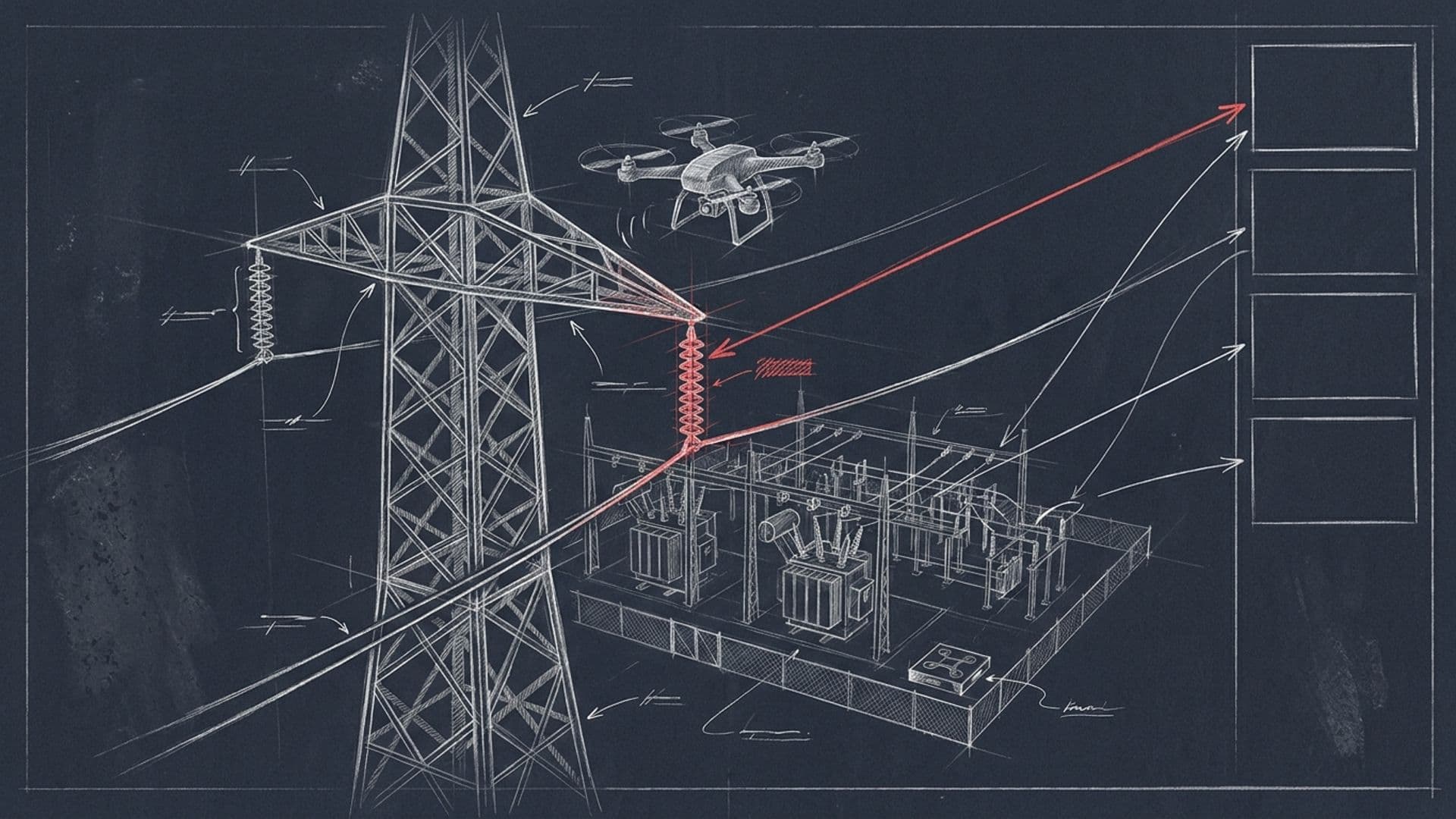
- Yes. Docked drones are sited inside or next to the substation fence and fly scheduled or triggered missions, capturing thermal and visible imagery for hotspot and equipment-condition checks alongside perimeter patrols. Docked systems such as drone-in-a-box infrastructure from makers including Dronehub, Skydio's Dock for X10, Percepto's drone-in-a-box and DJI's Dock 3 serve this use. Approvals still apply: remote operations need a specific-category authorisation in the EU and, in the US, a waiver until Part 108 is final.
- Can US utilities still buy DJI drones for inspection in 2026?
- Not new models. On 22 December 2025 the FCC added UAS and UAS critical components produced in foreign countries to its Covered List, so new models cannot receive FCC authorization and therefore cannot be imported or sold. The FCC says models it authorized before the listing can still be imported, sold and used, and drones already bought can keep flying. Exemptions cover items on DCMA's Blue UAS Cleared List and domestic end products under the Buy American Standard (until 1 January 2028), plus individual conditional approvals from the Department of War or DHS. The rule turns on where a drone is produced, not on the brand.
- Do utilities need BVLOS approval for power line drone inspection?
- For most corridor work, yes. In the US, Part 107 requires visual line of sight, so beyond-visual-line-of-sight flights need a waiver today; the proposed Part 108 would make BVLOS routine and treat airspace within 50 feet of power lines and substations as shielded when the owner agrees. In the EU, BVLOS falls in the specific category under Regulation (EU) 2019/947, and EASA's PDRA-G03 covers linear inspections over sparsely populated areas.
- Does the EU AI Act apply to AI power-line inspection?
- Possibly. Annex III, point 2 of the AI Act lists AI systems intended as safety components in the supply of electricity as high-risk. Whether an inspection model that flags defects for human review counts as a safety component is a legal assessment each utility should make with its vendor. The timing moved in 2026: Regulation (EU) 2026/1744 set 2 December 2027 as the date the high-risk obligations apply to Annex III systems.