Key facts
A US liquids pipeline operator must inspect surface conditions on or adjacent to each right-of-way at intervals not exceeding 3 weeks, at least 26 times each calendar year (49 CFR 195.412(a)); for gas transmission lines, 49 CFR 192.705 sets maximum patrol intervals by class location, from 15 months and at least once each calendar year (class 1 and 2, away from highway and railroad crossings) to 4½ months and at least four times each calendar year (class 4). Both sections list flying as an accepted way to travel the right-of-way.
Source · eCFR, 49 CFR 195.412(a) and 49 CFR 192.705 — https://www.ecfr.gov/current/title-49/subtitle-B/chapter-I/subchapter-D/part-195/subpart-F/section-195.412 ; https://www.ecfr.gov/current/title-49/subtitle-B/chapter-I/subchapter-D/part-192/subpart-M/section-192.705
PHMSA withdrew its July 2025 direct final rule on drones and satellites for right-of-way patrols on 2 October 2025 after receiving adverse comments, then proposed on 24 April 2026 (docket PHMSA-2025-0118) to clarify that patrol requirements are technology neutral; the comment period closed on 23 June 2026.
Source · Federal Register, 2025-19322 (withdrawal) and 2026-08080 (NPRM) — https://www.federalregister.gov/documents/2025/10/02/2025-19322/pipeline-safety-integration-of-innovative-remote-sensing-technologies-for-right-of-way-patrols-on ; https://www.federalregister.gov/documents/2026/04/24/2026-08080/pipeline-safety-integration-of-innovative-remote-sensing-technologies-for-right-of-way-patrols-on
The FAA's proposed Part 108 rule for flights beyond visual line of sight (NPRM published 7 August 2025, 90 FR 38212) covers unmanned aircraft up to 1,320 pounds; a search of the Federal Register on 29 October 2026 found no final rule, so Part 107 (small unmanned aircraft under 55 pounds, line of sight, waivable under 14 CFR 107.205) remains the baseline.
Source · Federal Register, 2025-14992 — https://www.federalregister.gov/documents/2025/08/07/2025-14992/normalizing-unmanned-aircraft-systems-beyond-visual-line-of-sight-operations ; eCFR, 14 CFR 107.3 and 107.205
5 more key facts
Under EPA's OOOOb rule, compressor stations must be surveyed with optical gas imaging or Method 21 at least quarterly after the initial survey, and the Administrator can approve an alternative test method for fugitive-emission screening under 40 CFR 60.5398b(d).
Source · eCFR, 40 CFR 60.5397b(g)(1)(v) and 60.5398b(d) ecfr.gov ↗
EPA's alternative test method MATM-14 (method dated 10 September 2025, approved by EPA on 30 September 2025) covers a drone-mounted optical gas imaging camera used for periodic screening at compressor stations and well sites under 40 CFR 60.5398b, with a field-verified sensitivity of 0.1 kg/hr of methane at 90% probability of detection, at standoff distances of 20 to 140 feet and winds up to 20 kph.
Source · EPA, Alternative Test Method MATM-14 (Percepto Air Max UAS) — https://www.epa.gov/system/files/documents/2025-09/percepto-matm-014-508-9.26-to-edit.pdf ; EPA, Oil and Gas Alternative Test Methods epa.gov ↗
EPA finalised a first, narrow reconsideration of OOOOb/c in April 2026 (flaring and flare vent-gas testing), extended several 2024 compliance deadlines in 2025, and on 29 October 2026 proposed a further reconsideration that would, among other changes, rescind the Super Emitter Program and amend the fugitive-emissions requirements; comments are due by 16 December 2026.
Source · EPA, Final Rule fact sheet, April 2026 — https://www.epa.gov/system/files/documents/2026-04/oil-and-gas-reconsideration-1_fact-sheet_0.pdf ; EPA, 2025 Interim Final Rule to Extend Compliance Deadlines — https://www.epa.gov/controlling-air-pollution-oil-and-natural-gas-operations/2025-interim-final-rule-extend-compliance ; Federal Register, 2026-22082 (proposed rule, 29 October 2026) federalregister.gov ↗
In the EU, BVLOS flights, drones over 25 kg and flights above 120 m fall in the specific category, which needs an operational authorisation from the national aviation authority unless a standard scenario or LUC applies; EASA's PDRA-G03 covers BVLOS linear inspections over sparsely populated areas but only for aircraft up to 3 m maximum dimension.
Source · EASA, Specific category — civil drones; EASA, Predefined risk assessment (PDRA) easa.europa.eu ↗
The S-2 hybrid VTOL has a 35 kg maximum take-off weight, up to 7 hours of endurance and up to 700 km of range (combustion cruise configuration, depending on payload), launches vertically from about 5×5 m, deploys in about 5 minutes and carries up to 5 kg in its payload bay; Dronehub's drone-in-a-box swaps the battery robotically in about 2 minutes and operates from −20 to +45 °C.
Source · Dronehub S-2 platform page — https://dronehub.ai/projects/s-2 ; Dronehub drone-in-a-box page dronehub.ai ↗
In this piece
Oil and gas drone inspection splits by distance and repetition. Fixed sites — compressor and pump stations, tank farms, terminals, refineries and clustered production sites — suit a drone-in-a-box that flies the same scheduled or alarm-triggered missions every day. Long pipeline right-of-way patrols suit a long-endurance hybrid VTOL aircraft such as Dronehub's S-2 (up to 7 hours, up to 700 km). Tank and vessel interiors need confined-space or contact drones. The rules differ by side of the Atlantic: in the US, FAA Part 107 waivers, PHMSA patrol intervals and EPA methane screening; in the EU, the EASA specific category and ATEX zoning.
Disclosure: this guide is published by Dronehub.
The sections below match the asset to the sensor and the aircraft, explain why distance decides the pipeline answer, and then set out the regulatory position as of 29 October 2026. For refinery-specific detail — hazardous-area zones, flare standoffs, permits — this guide links to the refinery drone inspection checklist instead of repeating it. Dronehub's energy page gives the overview across the grid, oil and gas and renewables; this post goes deeper on oil and gas.
Which oil and gas assets do drones inspect, and with which sensor?
Oil and gas has three segments. Upstream is wells and production facilities, midstream is gathering lines, pipelines, compressor and pump stations and storage, and downstream is refineries, terminals and tank farms. The table maps assets to sensor classes, aircraft type and cadence. Where a regulation sets a minimum, the cadence column gives it; where none does, the site's own plan governs.
Asset | What is inspected | Sensor class | Best aircraft type | Cadence |
|---|---|---|---|---|
Pipeline right-of-way, liquids | Encroachment, excavation, washouts, vegetation, visible spills | RGB zoom; radiometric thermal; optional methane or OGI | Long-endurance hybrid VTOL | At least 26 patrols a year, no more than 3 weeks apart (49 CFR 195.412(a)) |
Pipeline right-of-way, gas transmission | Same, plus surface signs of leaks | RGB zoom; radiometric thermal; laser methane | Long-endurance hybrid VTOL | By class location, from at least once a year to at least four times a year (49 CFR 192.705) |
Compressor and pump stations | Fugitive leaks on components, vents, hot bearings and motors | OGI; laser methane; radiometric thermal; RGB | Drone-in-a-box | US OOOOb compressor stations: OGI or Method 21 at least quarterly |
Tank farms | Roofs, shell, floating-roof seals, hot spots, bund condition | RGB zoom; radiometric thermal; OGI for vapour | Drone-in-a-box | Between formal inspections: site plan; API 653 external visual inspection at least every five years |
Tank and vessel interiors | Floor, shell, roof underside, wall thickness | RGB and thermal in a protective cage; contact ultrasonic | Confined-space or contact drone | Per the internal-inspection plan, after isolation |
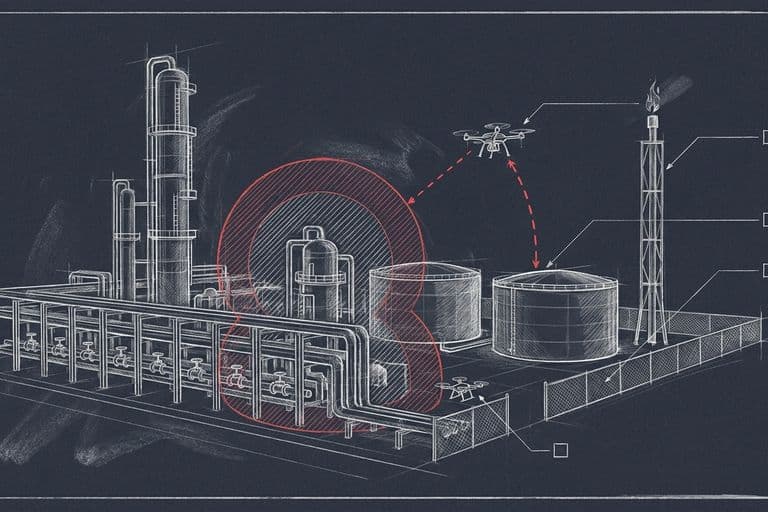
Refinery units, flares, columns | Flare tips, insulation, platforms, nozzles | Zoom RGB; radiometric thermal; OGI | Drone-in-a-box at standoff; campaign multirotor | Site plan; see the refinery checklist |
Terminals and site perimeter | Fence, gates, intrusion, night checks | RGB; radiometric thermal | Drone-in-a-box | Scheduled and alarm-triggered, per the security plan |
Production sites (upstream) | Fugitive components on wellheads, separators, tanks | OGI | Drone-in-a-box where sites cluster | US OOOOb: multi-wellhead sites OGI at least semiannually; sites with major equipment at least quarterly |
Four sensor classes recur in the table, each with a public example:
- Radiometric thermal returns a temperature for each pixel, not just a picture. DJI's Zenmuse H30T, for example, carries a 1280×1024 uncooled microbolometer and saves radiometric R-JPEG images.
- Optical gas imaging (OGI) makes gas visible in the mid-wave infrared. Teledyne FLIR's AerialOGI-N is a 640×512 mid-wave module for a drone gimbal that detects more than 25 gases including methane and VOCs.
- Laser absorption (TDLAS) measures methane concentration along a path. Pergam's Laser Falcon Supreme is described as a TDLAS methane detector for drones; SeekOps builds SeekIR to detect, locate and quantify drone-borne methane emissions.
- Contact and confined-space systems cover what a camera cannot. Voliro's Voliro T applies up to 30 N of stable force for contact inspection, including on assets in service, and Flyability's Elios 3 is built for visual and thermal inspection inside confined spaces without human entry.
A visible or thermal camera does not detect methane by itself. Gas work needs an OGI or laser payload, and whether a particular airframe can carry one is an integration question to put to any vendor.
Why does distance decide the aircraft for pipeline patrols?
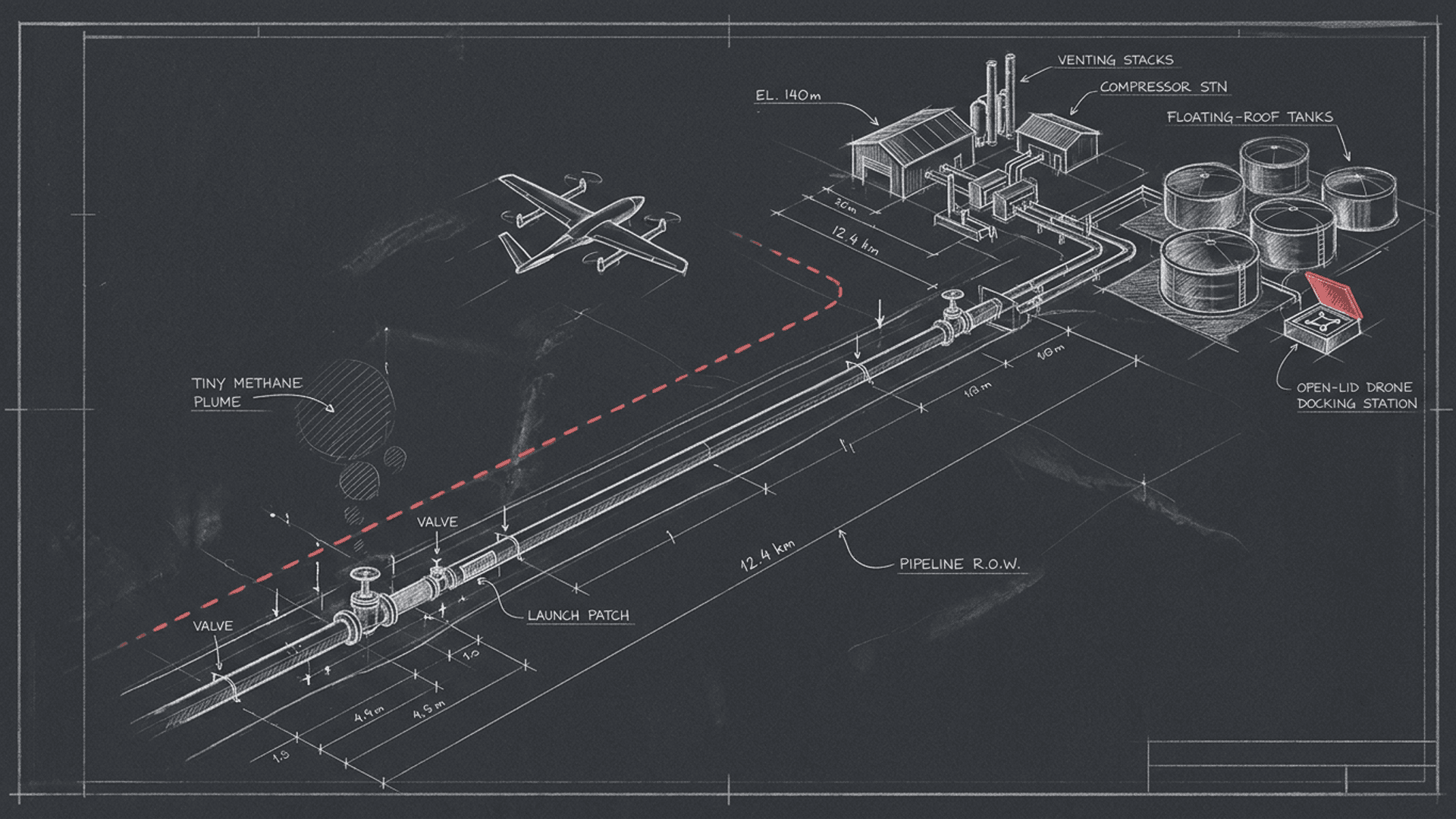
A multirotor drone-in-a-box is a site tool. Dronehub's dock page quotes about 20 km of mission coverage per drone per mission, which suits a station, a terminal or a short spur. A pipeline is the opposite problem: the asset is a corridor that can run for hundreds of kilometres, and the rule asks for repetition. A liquids line patrolled at the regulatory floor of 26 times a year means 2,600 km of right-of-way flown annually for every 100 km of pipe — simple arithmetic, not a benchmark. Flying that by multirotor means relocating a pilot and a vehicle every few kilometres.
Fixed-wing endurance with a multirotor's launch freedom closes that gap. That is the role of the S-2, the hybrid VTOL aircraft Dronehub develops and offers:
- Endurance and range: up to 7 hours and up to 700 km, depending on payload. The headline figures apply to the combustion-pusher configuration; an all-electric pusher variant is also available.
- Launch: vertical take-off and landing from about 5×5 m of flat ground, with about 5 minutes to airborne. A valve station, a pump-station yard or a road verge can serve as the launch point; no runway or catapult is needed.
- Payload: up to 5 kg in a 45 dm³ modular bay (6 kg total, excluding the standard electro-optical system), with electro-optical, thermal and task-built options.
- Envelope: 35 kg maximum take-off weight, 120 km/h cruise, wind to 10 m/s, −20 °C to +40 °C.
Dronehub's S-2 page lists pipelines, transmission corridors and rail as linear-asset missions where one sortie can cover a long run. It publishes no per-mission figures, so plan on payload, weather and approval limits rather than on the headline numbers. For how hybrid VTOL aircraft compare more broadly, see hybrid VTOL drones compared.
One point of design matters for the buyer: the S-2 is a field-launched aircraft, not a docked one. It does not live in the drone-in-a-box. A pipeline programme typically pairs the two by geography — S-2 sorties along the corridor, docks at the stations and terminals along it — rather than putting one aircraft in both roles.
Where does a drone-in-a-box fit at a compressor station, tank farm or terminal?
Site-bound assets reward autonomy because the route never changes and the risk is time. Dronehub's drone-in-a-box is a weatherproof dock with a robotic battery-swap mechanism: the drone lands, the pack is swapped in about 2 minutes, and the aircraft is staged for the next mission without anyone on site. It operates from −20 to +45 °C and is designed for 24/7 use. The dock's perimeter-security demonstration shows the two launch modes an oil and gas site needs: scheduled patrols and alarm-triggered launches, with automatic recovery.
In practice that gives a site four recurring jobs:
- Perimeter and fence-line patrol, scheduled at night and triggered by intrusion or gate alarms.
- Tank-farm surveys: roofs, floating-roof seals and shell hot spots by radiometric thermal and zoom RGB, repeated often enough to see change over time.
- Station walk-rounds: compressor buildings, vents, flare and pipe racks, with a thermal baseline per asset.
- Post-event look-sees: after a gas alarm, a flaring event or a storm, a launch before anyone enters the unit.
Why the swap matters. Docks that charge in place publish roughly 20–35 minutes between flights (DJI's Dock 3 about 27 minutes from 15% to 95%; Skydio's Dock for X10 about 35 minutes). A 2-minute swap gives close to twice the sorties over 24 hours on back-to-back missions. That matters for alarm response and for sites that want several look-rounds a night; it matters less for a single daily survey. The trade-off is more moving parts and a battery inventory. The full comparison is in drone-in-a-box systems compared.
Siting. A dock is electrical equipment. Place it outside classified hazardous zones unless it carries an Ex certification for the zone, and plan routes so that no flight crosses a zone the aircraft is not certified for. The refinery drone inspection checklist walks through zones, permit-to-work, standoffs and radio coordination; the same logic applies to tank farms and compressor stations.
What are the US rules for oil and gas drone inspection?
Four rule sets apply, and none replaces the others.
FAA operating rules. Part 107 governs small unmanned aircraft, defined as under 55 pounds at take-off (14 CFR 107.3), and requires the aircraft to stay in visual line of sight (107.31). That requirement is on the list of rules that can be waived (107.205), which is one way beyond-visual-line-of-sight work by small drones is approved today; heavier aircraft fly under FAA exemptions with their own weight limits. The FAA's proposed Part 108, published on 7 August 2025 (90 FR 38212), would create a performance-based framework for low-altitude BVLOS flight and cover aircraft up to 1,320 pounds. A search of the Federal Register on 29 October 2026 found no final rule, so plan on today's waiver and exemption routes. Two consequences follow. At 35 kg (about 77 pounds) the S-2 is above Part 107's weight limit and needs an FAA route outside it. And any proposed Part 108 text should be read for how it treats linear infrastructure when it is finalised.
PHMSA patrol requirements. Liquids operators must inspect the right-of-way at least 26 times a year, no more than 3 weeks apart (49 CFR 195.412(a)). Gas transmission operators follow class-location intervals in 49 CFR 192.705. Both sections list flying among the acceptable methods. PHMSA's July 2025 direct final rule to state that drones and satellites qualify was withdrawn on 2 October 2025 after adverse comments, and a new proposal published on 24 April 2026 would clarify that patrol requirements are technology neutral. Its comment period closed on 23 June 2026; we found no final rule. A drone patrol therefore replaces a walk, drive or crewed flight only where the imagery shows the surface conditions the rule is about, and the FAA side still has to be solved.
EPA methane rules (40 CFR 60 subparts OOOOb and OOOOc). OOOOb requires OGI or Method 21 surveys at least quarterly at compressor stations after the initial survey, at least semiannually at multi-wellhead sites, and quarterly at sites with major equipment (60.5397b). Section 60.5398b(d) lets EPA approve alternative test methods, and approvals are technology-specific. EPA's MATM-14 is the drone example: a drone-mounted OGI camera with cloud analytics, field-verified at 0.1 kg/hr of methane at 90% probability of detection under stated conditions, and approved by EPA on 30 September 2025. The regulatory timeline is moving. EPA extended several 2024 compliance deadlines in 2025, finalised a narrow reconsideration of flaring and vent-gas testing in April 2026, and on 29 October 2026 proposed a further reconsideration that would, among other changes, rescind the Super Emitter Program and amend the fugitive-emissions requirements (comments due 16 December 2026). Check EPA's OOOOb/c page and the Federal Register for current dates before you plan a compliance programme. Dronehub's pages do not claim an EPA-approved method; ask any vendor, including us, for the approval and its scope.
Site and airspace rules. The FAA's proposed Section 2209 rule, published on 6 May 2026, would let large refineries (100,000 barrels a day or more) and large natural gas processing plants (at least 500 million cubic feet a day) apply for drone flight restrictions over their sites; we found no final rule. The refinery checklist covers it.
What are the EU rules for oil and gas drone inspection?
Specific category. EASA places BVLOS flights, drones over 25 kg and flights above 120 m in the specific category. The operator needs an operational authorisation from the national aviation authority of the state of registration, unless a standard scenario or a light UAS operator certificate (LUC) applies. The authorisation follows a SORA risk assessment or a predefined risk assessment (PDRA). For pipeline patrols the relevant one is PDRA-G03: BVLOS linear inspections over sparsely populated areas. It is limited to a maximum dimension of 3 m. The S-2's wingspan is 3.55 m, so it would likely fall outside PDRA-G03 and need a full SORA authorisation; confirm with the national authority. A multirotor dock aircraft is a different case, and its fit depends on its own dimensions and the site's population density.
U-space. Commission Implementing Regulation (EU) 2021/664 sets the framework for U-space services — digital services that manage drone traffic — and Member States publish U-space airspace data through common information services. If a site or corridor lies inside designated U-space airspace, expect to coordinate through those services; the national authority tells you where that applies.
Methane and hazardous areas. The EU Methane Regulation (EU) 2024/1787 covers oil and gas production, gas transmission and distribution, underground storage and LNG facilities, but not refineries, which fall under the Industrial Emissions Directive. For ATEX zones, equipment categories and permit-to-work on process sites, use the refinery checklist.
How do I buy: the dock, the technology, or a partnership?
Dronehub offers three routes, which depend on who you are.
Route | Who it fits | What you get |
|---|---|---|
Buy the drone-in-a-box | Operators of pipelines, stations, terminals, tank farms | Dock, airframe, robotic battery swap, AI stack and operator interface |
License the technology | OEMs, integrators, drone companies, platform vendors | Docking, battery-swap and autonomy technology to build and sell under your own brand |
Partner or co-develop | Operators needing a custom variant | A site- or payload-specific version, for example for a specific gas payload, a climate or an approval route |
The S-2 is available by direct purchase, IP licence or build-to-spec configuration. We do not publish prices or delivery times on this page; request a scoped quote.
Other suppliers cover parts of the picture. Dronehub is listed first, followed by the others alphabetically; this is not a ranking.
Company | Role |
|---|---|
Drone-in-a-box with robotic battery swap; S-2 hybrid VTOL for long corridors | |
Flyability | Elios 3 confined-space drone for tanks and vessels |
FlytBase | Dock-agnostic dock software |
Percepto | Drone-in-a-box; Percepto's Air Max UAS is the subject of EPA MATM-14 |
Skydio | Dock for X10 |
Voliro | Contact-inspection drone (Voliro T) |
To scope a site or a corridor, request specs and a conversation.
FAQ
- Which drones are best for oil and gas inspection?
- It depends on distance and repetition. For fixed sites such as compressor stations, tank farms, terminals and refineries, a drone-in-a-box that launches, lands and swaps its own battery fits repeated, scheduled or alarm-triggered missions; Dronehub's dock does this with a roughly 2-minute robotic battery swap. For long pipeline right-of-way patrols, a long-endurance hybrid VTOL such as Dronehub's S-2 (up to 7 hours, up to 700 km on the combustion configuration, 35 kg, launched vertically from about 5×5 m) covers distance a multirotor cannot. The S-2 is a separate aircraft; it does not dock in the drone-in-a-box. Inside tanks and vessels, confined-space or contact drones do the work.
- Can drones detect methane leaks on pipelines and compressor stations?
- Yes, with the right sensor. Optical gas imaging cameras, such as Teledyne FLIR's AerialOGI-N module (25+ gases including methane and VOCs), show a plume and its source; laser absorption sensors such as Pergam's TDLAS-based Laser Falcon Supreme measure methane along a path. In the US, EPA has approved at least one drone OGI method, MATM-14, as an alternative test method for OOOOb periodic screening at compressor stations and well sites. A thermal or visible camera alone does not detect methane. Whether a given aircraft can carry a gas payload is a project-level question to put to any vendor.
- Are drones allowed for pipeline patrols under PHMSA rules?
- Existing rules already list flying as an acceptable way to patrol a right-of-way: 49 CFR 195.412(a) requires inspection at intervals of no more than 3 weeks and at least 26 times a year for liquids pipelines, and 49 CFR 192.705 sets class-location intervals for gas transmission lines. PHMSA tried to state this explicitly for drones and satellites in a July 2025 direct final rule, withdrew it after adverse comments in October 2025, and proposed a technology-neutral clarification on 24 April 2026. Flying the drone still has to comply with FAA rules.
- Do I need a BVLOS waiver to inspect a pipeline by drone?
- In the US, yes, for most pipeline work. Part 107 requires the aircraft to stay within visual line of sight (14 CFR 107.31), and that section can be waived under 107.205. Part 107 also covers only aircraft under 55 pounds, so a 35 kg aircraft like the S-2 would need an FAA route outside it. The proposed Part 108 would allow up to 1,320 pounds but was not final on 29 October 2026. In the EU, BVLOS and aircraft over 25 kg fall in the specific category, which needs an authorisation from the national authority, usually based on a SORA or a predefined risk assessment.
- Can a drone dock be used in a hazardous area at a gas plant or tank farm?
- Treat a dock as electrical equipment and site it outside classified zones unless it carries an Ex certification for the zone. Directive 1999/92/EC defines Zones 0, 1 and 2 and the equipment categories allowed in each, and most inspection drones carry no Ex certification. In practice, docks sit near the fence or outside the classified envelope, and aircraft observe classified areas from a standoff with zoom, thermal or gas payloads. Our refinery drone inspection checklist covers zones, permits-to-work and standoffs in detail, and applies equally to tank farms and compressor stations.
- What does an autonomous drone dock add over a manual drone team on an oil and gas site?
- Repeatability and response. A dock flies the same route on a schedule, can launch when a ground alarm triggers it, and returns and re-arms without a pilot on site. Docks that charge in place publish roughly 20–35 minutes between flights; Dronehub's robotic battery swap takes about 2 minutes, which gives close to twice the sorties over a 24-hour window on back-to-back missions. The trade-off is more moving parts and a battery inventory to maintain. Regulatory approval for remote operation is still required in both the US and the EU.
- Should an operator buy a drone dock, license the technology, or partner?
- Buy when you operate the sites and want working infrastructure: Dronehub sells the drone-in-a-box outright, with the dock, airframe, AI stack and operator interface. License when you are an integrator, OEM or platform company that wants to build and sell docks under your own brand; Dronehub licenses the docking, battery-swap and autonomy technology. Partner or co-develop when the site needs a custom variant, such as a specific gas payload or an unusual climate or approval route. The S-2 is available by direct purchase, IP licence or build-to-spec configuration. Dronehub's contact page routes all three.