Key facts
European defence, security and resilience startups raised a record $8.7 billion of venture capital in 2025, up 55% year on year and nearly four times the level of five years earlier, according to Dealroom and the NATO Innovation Fund.
Source · NATO Innovation Fund, 10 February 2026 nif.fund ↗
Helsing raised $1.8 billion in a Series E announced on 13 July 2026 that values the German defense-AI and strike-drone company at $18 billion; it remains privately held.
Source · CNBC, 13 July 2026 — https://www.cnbc.com/2026/07/13/helsing-fund-raise-defense-18-billion.html; tech.eu, 13 July 2026 tech.eu ↗
Quantum Systems signed a €1 billion Series D on 2 July 2026 at a post-money valuation of about €7 billion, co-led by Blackstone, Noteus, Airbus and Advent; the company says its systems flew more than 19,000 missions in Ukraine in 2025.
Source · EU-Startups, 2 July 2026 eu-startups.com ↗
3 more key facts
Tekever announced the first close of a $580 million Series D on 23 September 2026 at a $6.4 billion valuation, led by UC Investments and Baillie Gifford.
Source · Tekever, 23 September 2026 tekever.com ↗
The EU's SAFE instrument offers member states up to €150 billion in defence loans; small drones, NATO class 2 and 3 drones and anti-drone systems are eligible, and components from outside the EU, EEA-EFTA states and Ukraine may not exceed 35% of the end product's component cost.
Source · EUR-Lex, summary of Regulation (EU) 2025/1106 eur-lex.europa.eu ↗
Dronehub, founded in 2015 in Poland's Aviation Valley and now US-owned, licenses autonomous drone-in-a-box infrastructure with a two-minute robotic battery swap and states that its hardware contains no components from China, Russia, Iran or sanctioned states.
Source · Dronehub, About — https://dronehub.ai/about; Dronehub, Drone-in-a-Box dronehub.ai ↗
In this piece
The largest rounds in European defense drones in 2026 went to privately held companies: Helsing ($18 billion valuation, July 2026), Quantum Systems (about €7 billion, July 2026), Tekever ($6.4 billion, September 2026) and Stark (€3.2 billion, June 2026). None of them is listed, so investors who want shares they can buy today are limited to a few listed drone makers such as Parrot (Euronext Paris: PARRO) and to larger defense groups that run drone programmes. Public money — the EU's €150 billion SAFE loans, the European Defence Fund, NATO's venture fund and its accelerator — pays for procurement and R&D rather than buying equity.
Disclosure: this guide is published by Dronehub. We publish no valuation or funding figures for Dronehub. Every market figure links to its source and was checked on 28 September 2026; a private company's valuation is the price of its last funding round, not a market price. This article is for information only and is not investment advice.
The backdrop is a record year. European defence, security and resilience startups raised $8.7 billion of venture capital in 2025, up 55% on 2024 and nearly four times the level of five years earlier, according to Dealroom and the NATO Innovation Fund. The EU's ReArm Europe / Readiness 2030 plan aims to unlock up to €800 billion of additional defense spending, and Helsing, Quantum Systems and Tekever all have systems in use in Ukraine.
Listed or private: the companies at a glance
Share prices move every day, so the table lists exchanges and tickers, not prices. Our own company comes first; other private companies follow, ordered by their latest disclosed valuation, then those without one; listed companies follow alphabetically.
Company | Country | Drone business | Status (September 2026) | Latest disclosed valuation or 2026 event |
|---|---|---|---|---|
Dronehub (publisher) | US / Poland | Drone-in-a-box infrastructure, licensed | Private | Not disclosed |
Germany | Defense AI, HX-2 strike drones, CA-1 Europa combat drone | Private | $18B after a $1.8B Series E (July 2026) | |
Germany | Vector, Twister and Trinity electric VTOL UAVs | Private; IPO preparation reported, not announced | ~€7B post-money after a €1B Series D (July 2026) | |
Portugal / UK | AR3 and AR5 surveillance UAVs | Private | $6.4B at the first close of a $580M Series D (September 2026) | |
Germany | Virtus loitering munition | Private | €3.2B after a €500M round led by Sequoia and Founders Fund (June 2026) | |
Poland | FlyEye mini-UAV, Warmate loitering munitions | Private; Warsaw IPO discussed, no decision | Not disclosed | |
Germany | Delivery drones; Wingcopter 262 reconnaissance drone (September 2026) | Private | Not disclosed | |
Pan-European | Industrial prime of the U950 Eurodrone; co-led Quantum Systems' Series D | Listed: Euronext Paris, AIR | Market price | |
France | Civilian professional drones (heavy-lift, inspection, surveillance) | Listed: Euronext Growth Paris, ALDRV | Market price; first-half 2026 sales of €4.2M | |
France | Maritime surface and underwater drones | Listed: Euronext Paris, EXA | Thales agreed in July 2026 to buy the Gorgé family's 35.51% and bid for 100% at €134 a share | |
France | ANAFI professional micro-drones | Listed: Euronext Paris, PARRO | Market price | |
Germany | LUNA NG reconnaissance drone, inside a large defense group | Listed: Xetra, RHM | Market price |
What the table tells an investor:
- The pure-play defense-drone leaders are private. Exposure to them runs through venture and growth funds, secondary deals or a future IPO. Reuters reported in February 2026 that Quantum Systems was preparing for a listing that could come by early 2027, and Bloomberg reported in May that Quantum and Destinus were lining up banks. Neither has announced an IPO.
- Listed exposure is small or indirect. Parrot and Drone Volt are small drone makers; Rheinmetall and Airbus carry drones inside much larger businesses (Airbus also co-led Quantum Systems' Series D); Exail is the subject of an agreed Thales takeover.
- The biggest defense IPO of 2026 was not a drone specialist. Czechoslovak Group (CSG) listed on Euronext Amsterdam on 23 January 2026, raising €3.8 billion at a €25 billion market value — the largest defense IPO on record, per Euronext. It shows appetite for European defense stocks, not for drones specifically.
- Poland's WB Group is unlisted. Its CEO (45.49%), deputy CEO (28.07%) and the state-owned Polish Development Fund, PFR (26.44%), own it. On 9 September 2026 the CEO called a Warsaw listing only one of the options, with no shareholder resolution passed; PFR has said 2027 is more likely if it happens.
The manufacturer tiers — and where the money went
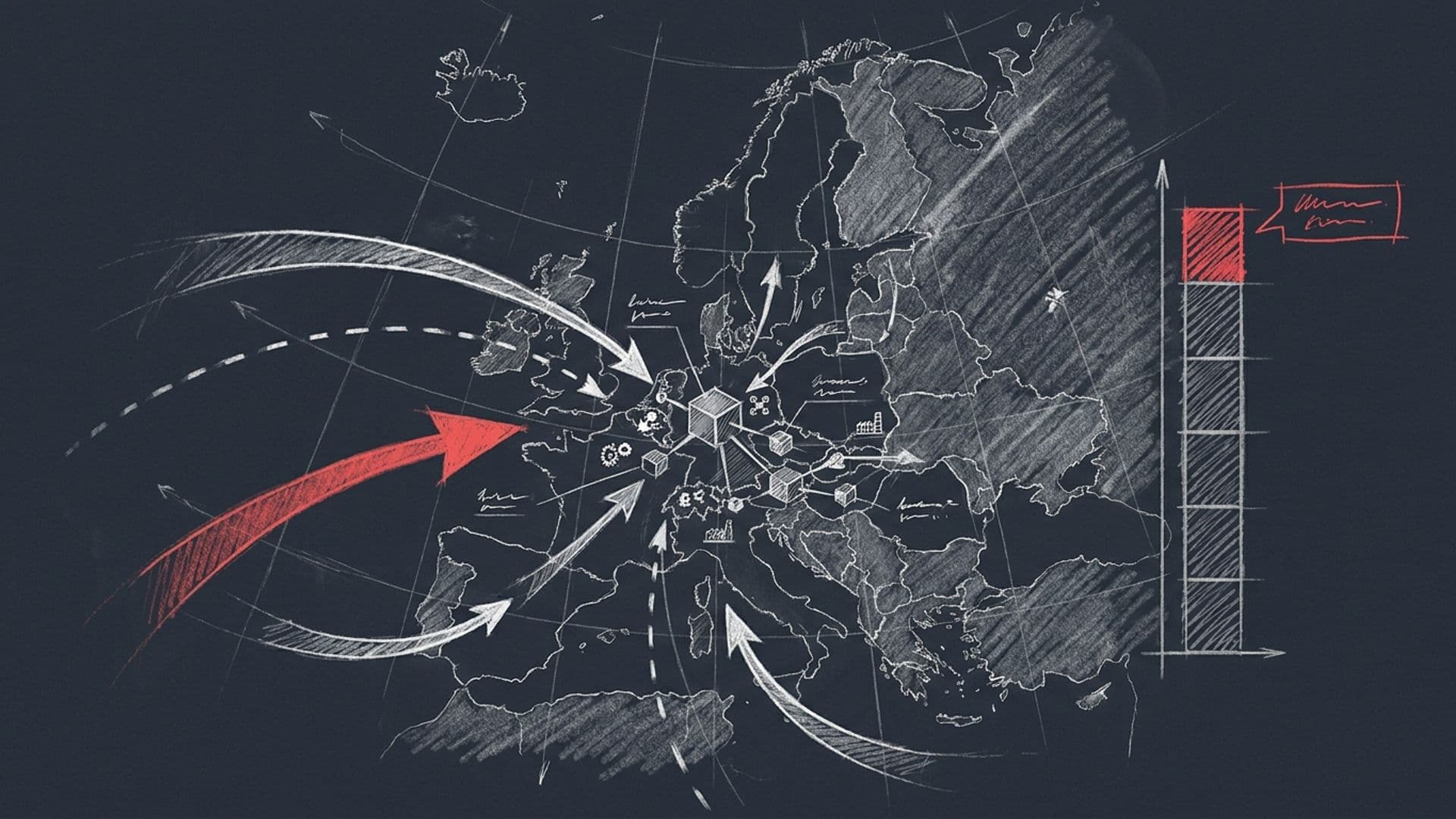
Capital did not spread evenly. It concentrated where systems were already fielded and tied to government demand.
The infrastructure layer
Aircraft get the headlines and nearly all of the capital in the tiers below. The ground layer — docks, battery logistics, AI analytics — decides whether they operate autonomously at scale. Dronehub, the publisher of this article, works in this layer; it has its own section below.
The defense-AI and reconnaissance tier — the unicorns
- Helsing (Germany) — defense AI plus the hardware it runs on: HX-2 strike drones, which CNBC reports are among the systems supplied to Ukraine's army, and the CA-1 Europa combat drone. Its $1.8 billion Series E in July 2026 valued it at $18 billion.
- Quantum Systems (Germany) — electric VTOL reconnaissance and mapping UAVs (Vector, Twister, Trinity). It became a unicorn with a €160 million Series C in May 2025, passed €3 billion with a €180 million extension that November, added a €150 million debt package anchored by a €70 million EIB loan in February 2026, and in July 2026 signed a €1 billion Series D at about €7 billion post-money. The company says its systems flew more than 19,000 missions in Ukraine in 2025.
- Tekever (Portugal / UK) — AR3 and AR5 surveillance UAVs, with more than 50,000 operational flight hours in Ukraine since 2022, per CNBC. It became a unicorn in May 2025 in a round the NATO Innovation Fund joined, holds a €30 million EMSA framework contract for the AR5, and was selected for the British Army's CORVUS surveillance programme, worth up to £400 million over ten years. On 23 September 2026 it announced the first close of a $580 million Series D at a $6.4 billion valuation.
The tactical and loitering-munitions tier
- Stark (Germany) — the Virtus loitering munition, with an agreement signed in February 2026 to supply several thousand Virtus systems to the German armed forces. Its €500 million round in June 2026 was led by Sequoia Capital and Founders Fund, with the NATO Innovation Fund taking part; Bloomberg reported a valuation of €3.2 billion.
- WB Group (Poland) — the established prime: FlyEye reconnaissance mini-UAVs and Warmate loitering munitions. Unmanned systems made up 20% of group revenue in figures it presented at MSPO 2026, and PFR told Parkiet in June that winning SAFE-funded contracts had been the owners' top priority. Not all capital in this sector is venture money.
The commercial-and-delivery tier, moving into defense
- Wingcopter (Germany) — tilt-rotor delivery drones with a medical and logistics heritage. Its last disclosed round, in June 2025, included the European Investment Bank; no amount was published. In 2026 it set up a security-and-defence unit, signed a memorandum with Ukraine's TAF Industries on a joint venture in February, and launched the Wingcopter 262 reconnaissance drone in September.
- Parrot (France) — listed on Euronext Paris since June 2006. Its ANAFI line is a professional micro-drone family, and Parrot markets the ANAFI USA as NDAA and TAA compliant.
The funding routes — the real "investment options"
For anyone evaluating the sector, the more useful map is not the companies but the capital channels. Five matter for companies directly, and they stack.
Route | Type | What it provides (checked September 2026) | Best for |
|---|---|---|---|
Private VC / growth equity | Dilutive | From seed tickets to Helsing's $1.8B and Quantum Systems' €1B rounds of July 2026 | Fielded systems with government traction |
Dilutive (allied) | A €1B+ venture fund backed by 24 NATO allies; took part in Tekever's 2025 and Stark's 2026 rounds | Dual-use deep tech, autonomy included | |
Non-dilutive | €100,000 of contractual funding in the accelerator, up to €300,000 more in the Mission Track, access to its test-centre network | Early-stage dual-use hardware | |
Non-dilutive | €1B for collaborative defence R&D in the 2026 work programme; consortia from at least three EU countries or Norway | Multi-partner capability development | |
Grant + optional equity | Grants up to €2.5M and investments of €0.5M–€10M; open to dual-use since 17 June 2026; a separate €100M STEP Scale Up Defence call offers up to €30M of equity, drones included | Deep-tech SMEs scaling a breakthrough |
Underneath all five sits the agency layer — the European Space Agency, the European Defence Agency, EUSPA and Horizon Europe — which provides non-dilutive R&D capital long before a venture round. We break down how NATO DIANA's dual-use pipeline works, how European Defence Fund C-UAS calls actually run and the EIC Accelerator's grant-plus-equity mechanics in separate guides.
Above them sits procurement money, which decides who gets the orders these routes prepare companies for. SAFE lends up to €150 billion to member states for defense purchases; 19 member states submitted investment plans, and small drones, NATO class 2 and 3 drones and anti-drone systems are explicitly eligible. Pre-financing is flowing: Romania, Bulgaria and Latvia alone received over €3.5 billion in late August 2026. The €1.5 billion European Defence Industry Programme (EDIP) adds industrial grants, including an €80 million call for unmanned and counter-unmanned systems in its Ukraine support strand.
Reading the capital signals
Four quieter signals predict where the next capital goes.
- Fielded status. A system in operational use — on a front line, on a national border, inside a critical-infrastructure contract — is worth more than the same system in a demo. The four largest private valuations above all belong to companies with systems already in service.
- Framework contracts over one-off orders. A multi-year government framework is a recurring-revenue signal that investors read like a long-term contract. Stark's Bundeswehr agreement and Tekever's CORVUS selection are the pattern.
- The non-dilutive base. In our experience, clearing an ESA, EDA or EDF evaluation is a credential: the company arrives at a venture round already checked by independent technical reviewers.
- Entity structure. Whether a company can sell into both the EU (SAFE, EDF) and the US (NDAA, and SBIR/STTR, reauthorised on 13 April 2026 through September 2031) widens its addressable market.
That is why two companies with similar technology can carry very different valuations.
The filter that comes before any of it
None of these routes open until a company passes one test: where its parts come from and who controls it.
- SAFE and EDIP (EU). For purchases financed by SAFE loans, components from outside the EU, EEA-EFTA states and Ukraine may not exceed 35% of the end product's component cost, and contractors must be established there and not controlled from outside (EUR-Lex summary). EDIP applies a similar 35% ceiling.
- European Defence Fund (EU). Recipients and subcontractors must be EU-based, with their executive management in the EU, and must not be controlled by a non-associated third country (EDF eligibility).
- NDAA Section 848 (US). The Department of Defense may not operate or buy drones made in China, Russia, Iran or North Korea or by companies domiciled there, or drones that use their flight controllers, radios, data links, cameras, gimbals, ground-control systems or software (10 U.S.C. 4871 note).
- EDIS (EU strategy, March 2024). Not a purchasing rule in itself, but it sets the direction: member states are invited to procure at least 50% of their defence procurement budget within the EU by 2030 and 60% by 2035.
For the budgets that drive this sector, the vendor pool shrinks to allied suppliers with auditable supply chains before any feature or price comparison — and investors price that in.
Where the infrastructure layer fits
Dronehub, the publisher of this article, sells its drone-in-a-box outright and licenses the technology behind it to other drone companies. It was founded in 2015 by Vadym Melnyk in Poland's Aviation Valley (Rzeszów); today it is US-owned, with US headquarters in the Research Triangle, North Carolina, and its production line in Jasionka, Poland. Its focus is the autonomous ground layer, which it sells and licenses: drone-in-a-box systems with a two-minute robotic battery swap, mobile and stationary charging stations, docking systems, and Sentinel, its in-house AI anomaly-detection software. Its R&D record includes AUDROS, a counter-UAS system developed under joint European Space Agency and European Defence Agency programmes, and HUUVER, a Horizon 2020 hybrid UAV-UGV project with Galileo authentication.
Our reading for investors, not a market statistic: the large rounds above went to aircraft and strike systems; the docks, battery logistics and AI analytics that let those aircraft operate without a crew on site are a smaller column. Dronehub works in that column on the compliant side of the filter: it states that its hardware contains no components from China, Russia, Iran or sanctioned states, that it is Section 848 / 889 / 1260H compliant by design, and that its US entity is SBIR/STTR-eligible. We publish no valuation or funding figures.
Three things to watch for the rest of 2026
- The IPO window. Quantum Systems is reported to be preparing a listing for as soon as early 2027, and WB Group's shareholders are discussing one. Until then, the highest-valued companies stay private.
- SAFE money becoming orders. Loans are being paid out, and the 35% component ceiling decides which drone and counter-drone suppliers can take part.
- The supply-chain filter comes first. Under SAFE, EDIP, the EDF and NDAA Section 848, allied and auditable beats cheaper and faster for every sensitive budget.
For the company-by-company view, see the top European drone companies guide; for the non-dilutive routes, the NATO DIANA and EDF breakdowns; for the compliance side, NDAA Section 848 compatible drones. Or, if you are evaluating the infrastructure layer specifically, talk to us.
FAQ
- Where is defense-drone investment concentrated in Europe in 2026?
- In a handful of privately held companies whose systems are already in service. Helsing raised $1.8 billion at an $18 billion valuation in July 2026, Quantum Systems signed a €1 billion Series D at about €7 billion the same month, Stark raised €500 million in June, and Tekever announced $580 million at a $6.4 billion valuation in September. Across the wider sector, European defence, security and resilience startups raised a record $8.7 billion in 2025, according to Dealroom and the NATO Innovation Fund. Capital follows procurement signals, not pitch decks.
- Which European defense-drone companies can you buy shares in?
- Few of the leaders. Helsing, Quantum Systems, Tekever, Stark, Wingcopter and Poland's WB Group are all privately held as of September 2026. Listed options are small drone makers such as Parrot (Euronext Paris: PARRO) and Drone Volt (Euronext Growth Paris: ALDRV), or large defense groups with drone programmes inside them, such as Rheinmetall (Xetra: RHM) and Airbus (Euronext Paris: AIR). Exail (Euronext Paris: EXA) builds maritime drones and is the subject of a Thales takeover agreed with the Gorgé family in July 2026. Quantum Systems has been reported to be preparing a listing as soon as early 2027, but nothing has been announced. This is not investment advice.
- Which European drone companies are unicorns in 2026?
- At least four defense-drone companies are valued above $1 billion: Helsing ($18 billion, July 2026), Quantum Systems (about €7 billion post-money, July 2026), Tekever ($6.4 billion, September 2026) and Stark (€3.2 billion after its June 2026 round, per Bloomberg). All four are private, so these are the prices of their last funding rounds, not market prices. The pattern is consistent: each has systems in operational use, and Helsing, Quantum Systems and Tekever all have systems in use in Ukraine.
- What public funding is available for European defense-drone companies?
- Four routes matter. The NATO Innovation Fund is a €1 billion-plus venture fund backed by 24 allies that has invested in Tekever and Stark. NATO DIANA gives selected companies €100,000 of contractual funding in its accelerator and up to €300,000 more in its Mission Track, plus access to its test-centre network. The European Defence Fund earmarked €1 billion for collaborative defence R&D in its 2026 work programme. The EIC Accelerator, open to dual-use projects since 17 June 2026, combines grants of up to €2.5 million with investments of €0.5 million to €10 million. SAFE's €150 billion of loans goes to governments for procurement, not to companies directly.
- Why do supply-chain rules decide where defense-drone money can go?
- Because the biggest budgets carry origin rules. Purchases financed by the EU's SAFE loans must keep components from outside the EU, EEA-EFTA states and Ukraine to no more than 35% of component cost, and the EDIP industry programme applies a similar 35% ceiling. European Defence Fund money requires companies based in the EU or Norway and not controlled from outside. In the US, NDAA Section 848 bars the Department of Defense from buying drones made in China, Russia, Iran or North Korea, or drones using their flight controllers, radios, cameras or software. A company that fails these filters is not addressable for those budgets, and investors price that in.
- Where does the drone-infrastructure layer fit for investors?
- It is a smaller column than aircraft and strike systems, which took the large rounds of 2025 and 2026. Docks, robotic battery logistics and AI analytics are what let drones operate without a crew on site. Dronehub, the publisher of this article, licenses that layer: drone-in-a-box systems with a two-minute robotic battery swap, charging and docking hardware, and in-house AI anomaly detection, with production in Jasionka, Poland, and a US-owned parent company. Dronehub publishes no valuation or funding figures.